Garden Jardín

Clematis Clematis

Clematis spp.

Clematis brings flowers up into fences, trellises, and shrubs, giving Salem gardens vertical bloom without the bulk of a full climbing rose if the roots are drained and the support is chosen well. Clematis brings flowers up into fences, trellises, and shrubs, giving Salem gardens vertical bloom without the bulk of a full climbing rose if the roots are drained and the support is chosen well.
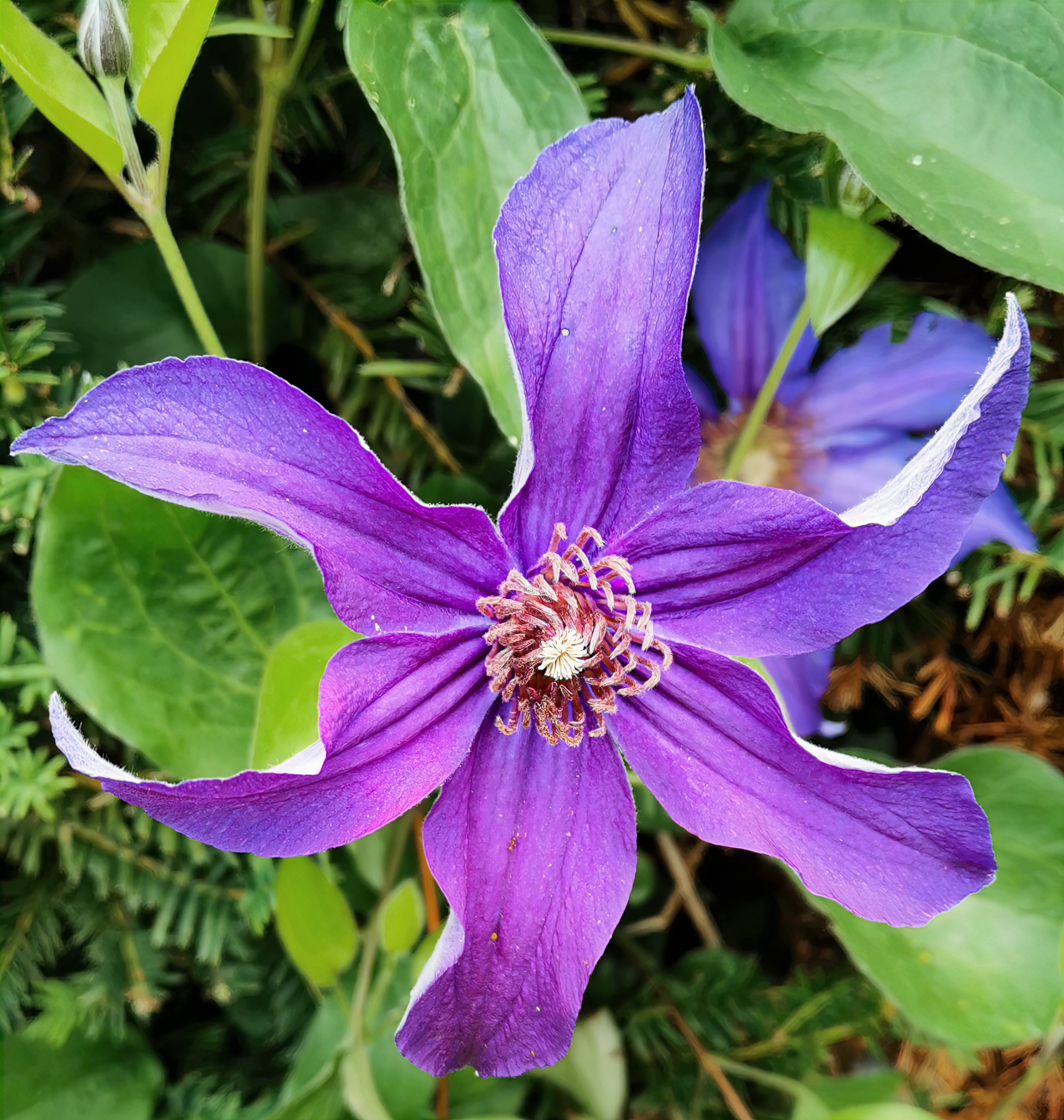
A clematis flower open against green foliage

Flowers Up Where the Eye Already Goes

A good clematis changes the way a garden uses vertical space. Instead of asking every bit of color to happen at knee height, it climbs into a trellis, over a gate, through a shrub, or along a wire and puts bloom where the eye naturally travels. That alone makes it valuable.

Clematis is also one of those broad garden groups that rewards choosing the right type instead of talking as if every form behaves the same. Some are big summer-flowering hybrids. Some are smaller and more graceful. Some are evergreen and a little more tender. Some, like sweet autumn clematis, can be too free with seed and should not be the default choice.

At The Patient Garden, the value of clematis is not just the flower itself. It is the ability to add seasonal bloom to an existing structure without planting another heavy shrub into the Fairview clay.

Why It Can Work Here

Salem gives clematis a long enough growing season and generally mild enough winters for many good garden forms. The main question is root condition. Clematis likes a soil that is fertile, cool at the root, and drained enough that winter saturation does not suffocate the crown.

That means our heavy clay is both an advantage and a warning. The moisture retention can help during summer, but only if the planting hole has been loosened well and the crown is not sitting in a basin. Planting a little high, improving the surrounding soil broadly rather than digging a narrow pit, and keeping mulch around the roots are all more useful than overcomplicating the recipe.

The old garden saying about "head in the sun, feet in the shade" is a simplification, but it points in the right direction. Most clematises bloom best with plenty of light above while the root zone stays cooler and more even.

Year by Year

Clematis often teaches patience. In the first year, a newly planted vine may look more concerned with survival than performance. Growth can be sparse while the plant settles its roots.

By the second year, you usually start to see the real direction of the plant. Stems lengthen, branching improves, and bloom begins to feel more intentional.

By year three and beyond, a well-sited clematis becomes part of the structure of the garden rather than a temporary accent. It will still need tying, guiding, and pruning appropriate to its group, but it begins to earn the space its support occupies.

Native Status, Good Choices, and Bad Ones

Most garden clematises are not native to Oregon. They come from Europe, Asia, and horticultural breeding lines built from species across the Northern Hemisphere. In Salem gardens, most of the familiar large-flowered and viticella types are well-behaved.

The caution is with aggressive self-sowers such as sweet autumn clematis. If the goal is a practical genus-level entry for local gardeners, that warning belongs here. We do not need to treat every clematis as interchangeable. A restrained hybrid or a good viticella is a very different garden citizen from a vine that throws seed everywhere.

Pollinators and Seasonal Value

Clematis flowers are visited by bees and other insects, especially the simpler, less doubled forms. Even when the flowers are not major nectar powerhouses, the vines contribute cover, seasonal texture, and later seedheads that extend their interest. Some seedheads are worth leaving for a while simply because they keep the vine looking alive after bloom.

Growing Tips for the Fairview Clay

Plant in full sun to part shade depending on the variety, with support in place from the beginning. Loosen the soil wide, not just deep. Add compost for structure and enough mineral material to keep the clay from sealing up around the roots. Mulch the root area to moderate heat and moisture.

The most practical advice is to know the pruning group before cutting anything hard. Some clematises bloom on old wood, some on new wood, and some on both. If you cannot identify the group right away, prune lightly until the plant shows you its rhythm.

Where It Belongs

In The Patient Garden, clematis belongs on fences, obelisks, porch rails, and in partnership with shrubs that can carry a lighter vine through them. It is especially valuable where we want bloom above the border without planting another large woody plant. On the Fairview clay, that kind of efficient use of space is no small thing.

Flowers Up Where the Eye Already Goes

A good clematis changes the way a garden uses vertical space. Instead of asking every bit of color to happen at knee height, it climbs into a trellis, over a gate, through a shrub, or along a wire and puts bloom where the eye naturally travels. That alone makes it valuable.

Clematis is also one of those broad garden groups that rewards choosing the right type instead of talking as if every form behaves the same. Some are big summer-flowering hybrids. Some are smaller and more graceful. Some are evergreen and a little more tender. Some, like sweet autumn clematis, can be too free with seed and should not be the default choice.

At The Patient Garden, the value of clematis is not just the flower itself. It is the ability to add seasonal bloom to an existing structure without planting another heavy shrub into the Fairview clay.

Why It Can Work Here

Salem gives clematis a long enough growing season and generally mild enough winters for many good garden forms. The main question is root condition. Clematis likes a soil that is fertile, cool at the root, and drained enough that winter saturation does not suffocate the crown.

That means our heavy clay is both an advantage and a warning. The moisture retention can help during summer, but only if the planting hole has been loosened well and the crown is not sitting in a basin. Planting a little high, improving the surrounding soil broadly rather than digging a narrow pit, and keeping mulch around the roots are all more useful than overcomplicating the recipe.

The old garden saying about "head in the sun, feet in the shade" is a simplification, but it points in the right direction. Most clematises bloom best with plenty of light above while the root zone stays cooler and more even.

Year by Year

Clematis often teaches patience. In the first year, a newly planted vine may look more concerned with survival than performance. Growth can be sparse while the plant settles its roots.

By the second year, you usually start to see the real direction of the plant. Stems lengthen, branching improves, and bloom begins to feel more intentional.

By year three and beyond, a well-sited clematis becomes part of the structure of the garden rather than a temporary accent. It will still need tying, guiding, and pruning appropriate to its group, but it begins to earn the space its support occupies.

Native Status, Good Choices, and Bad Ones

Most garden clematises are not native to Oregon. They come from Europe, Asia, and horticultural breeding lines built from species across the Northern Hemisphere. In Salem gardens, most of the familiar large-flowered and viticella types are well-behaved.

The caution is with aggressive self-sowers such as sweet autumn clematis. If the goal is a practical genus-level entry for local gardeners, that warning belongs here. We do not need to treat every clematis as interchangeable. A restrained hybrid or a good viticella is a very different garden citizen from a vine that throws seed everywhere.

Pollinators and Seasonal Value

Clematis flowers are visited by bees and other insects, especially the simpler, less doubled forms. Even when the flowers are not major nectar powerhouses, the vines contribute cover, seasonal texture, and later seedheads that extend their interest. Some seedheads are worth leaving for a while simply because they keep the vine looking alive after bloom.

Growing Tips for the Fairview Clay

Plant in full sun to part shade depending on the variety, with support in place from the beginning. Loosen the soil wide, not just deep. Add compost for structure and enough mineral material to keep the clay from sealing up around the roots. Mulch the root area to moderate heat and moisture.

The most practical advice is to know the pruning group before cutting anything hard. Some clematises bloom on old wood, some on new wood, and some on both. If you cannot identify the group right away, prune lightly until the plant shows you its rhythm.

Where It Belongs

In The Patient Garden, clematis belongs on fences, obelisks, porch rails, and in partnership with shrubs that can carry a lighter vine through them. It is especially valuable where we want bloom above the border without planting another large woody plant. On the Fairview clay, that kind of efficient use of space is no small thing.

Continue Continuar

Keep following the pattern Seguir el patron