Star jasmine
Trachelospermum jasminoides
Star jasmine is a twining evergreen vine grown for glossy foliage, intense spring fragrance, and dense screening habit. In mild climates it functions as both a flowering vine and a dependable green wall plant.
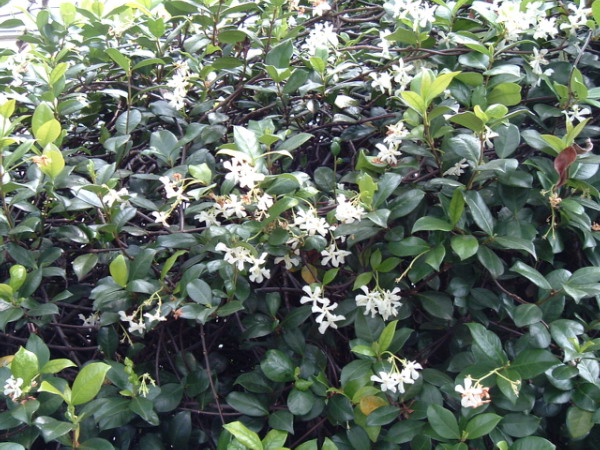
Star jasmine is not a true jasmine, but it is one of the most effective evergreen flowering vines for residential gardens. Its dark, glossy leaves create a tidy backdrop for clusters of white pinwheel flowers that release a strong sweet fragrance in late spring and early summer.
Given support, it climbs by twining and can cover fences, trellises, and porch structures; without support it can also be used as a mounding groundcover. The plant is often valued as much for its year-round coverage as for the bloom itself.
It grows best in sun to part shade with reasonably well-drained soil and regular water while establishing. Once rooted in, it becomes fairly adaptable, though the densest flowering and strongest growth usually come from bright exposures with warmth and some shelter from cold wind.
The flowers are visited by bees and other pollinators, but for many gardeners the defining qualities are fragrance, texture, and versatility. It responds well to pruning after bloom and can be kept formal or allowed to soften around structures.
In a neighborhood garden, star jasmine often solves the practical problem of wanting evergreen coverage without sacrificing flowers, especially in narrow side yards or along fences where a softer screen is needed.
Microclimate
Star jasmine gains speed in warm, bright, protected exposures where reflected heat helps ripen growth. It can tolerate part shade, but bloom and fragrance are usually reduced there. Cold wind and deep winter shade slow it down, while wall-adjacent plantings often become denser and more evergreen-looking through the year.
Neighborhood observations
In neighborhood settings, star jasmine often performs best on fences, gates, and porch edges where roots are shaded but the foliage reaches sun. Plants in cramped, unirrigated strips can survive, but they rarely make the thick, flowering screen people are usually after.