American kestrel
Falco sparverius
American kestrel is the smallest North American falcon, a compact predator of open country and edges that sometimes uses neighborhood perches, wires, and snags to hunt insects and small vertebrates.
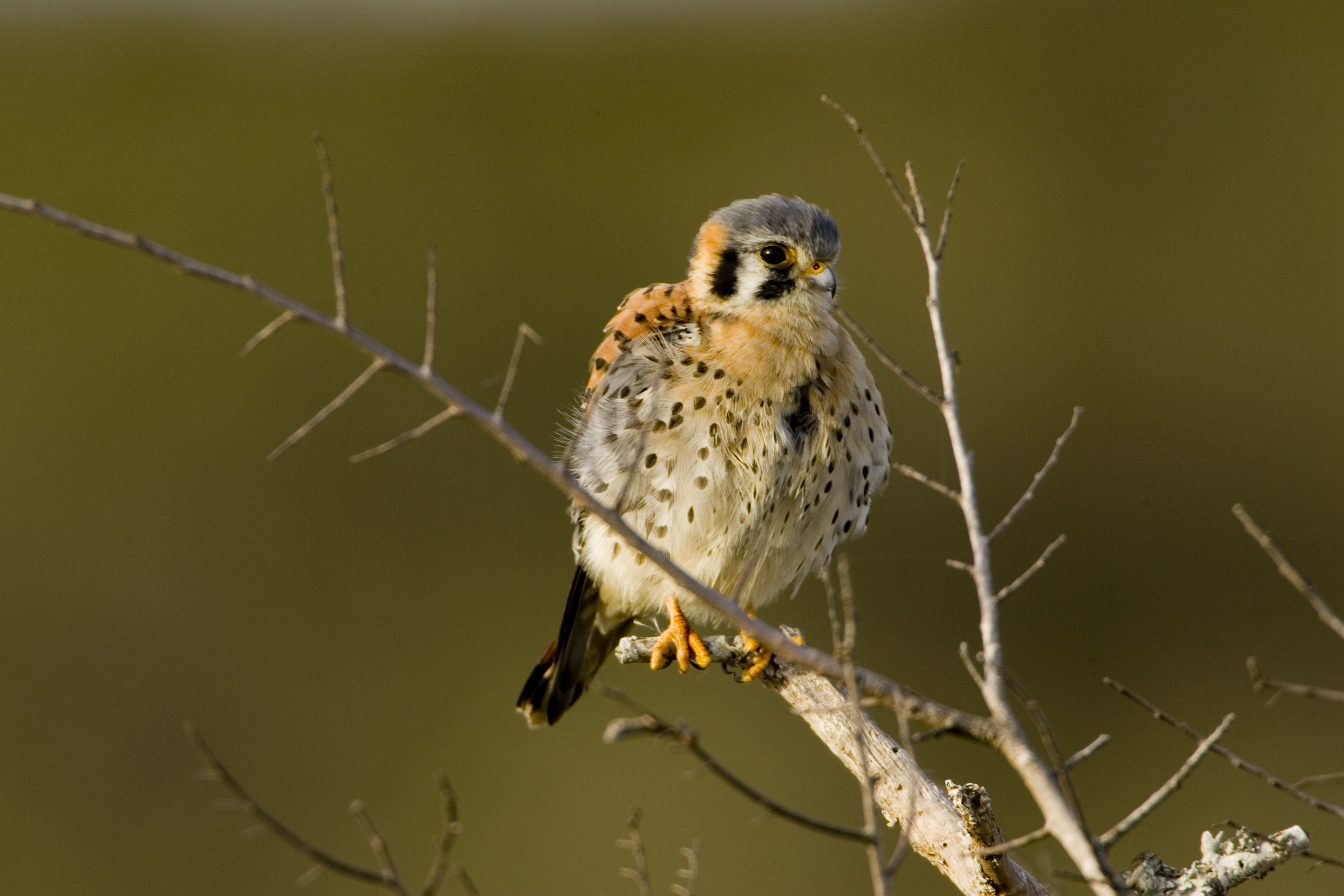
American kestrel is a small falcon with a disproportionately bold personality: quick-winged, upright, and sharply marked, with rusty upperparts, spotted backs, and dark facial stripes. Males and females differ subtly in pattern, but both project alertness and speed.
Kestrels hunt by perching and scanning or by hovering briefly over open ground before dropping onto prey. They are most at home in open habitats, agricultural edges, grasslands, and broad clearings, but they also move through neighborhood margins where enough visibility and prey remain.
Their diet includes large insects, small rodents, lizards, and small birds, which makes them especially responsive to landscapes that retain rough grass, field edges, fence lines, and other hunting structure. They do not require a manicured scene; they require a readable one.
Compared with larger raptors, kestrels feel nimble and intermittent in residential areas, more likely to flash across a street or pause on a wire than to dominate a site for long periods. Still, their appearance can be one of the most memorable signs that a neighborhood connects to surrounding open habitat.
Because kestrels rely on cavities for nesting and open ground for hunting, they benefit from a broader habitat mosaic than a single yard can provide. Even so, neighborhood plantings and tree choices can contribute to the edges and prey base they use.
Microclimate
Kestrels use warm, open airspace and exposed perch networks rather than sheltered garden interiors. Sunny edges, utility lines, snaggy trees, and open strips that hold insect and rodent activity are the microclimatic pieces that matter most to them.
Neighborhood observations
In neighborhood contexts, kestrels are usually birds of the edge rather than the center. They are most likely where residential blocks transition into fields, school grounds, wide medians, or undeveloped lots that preserve hunting visibility.