American crow
Corvus brachyrhynchos
American crow is one of the most visible and adaptable neighborhood birds, combining intelligence, social behavior, and a remarkable ability to use human-shaped landscapes.
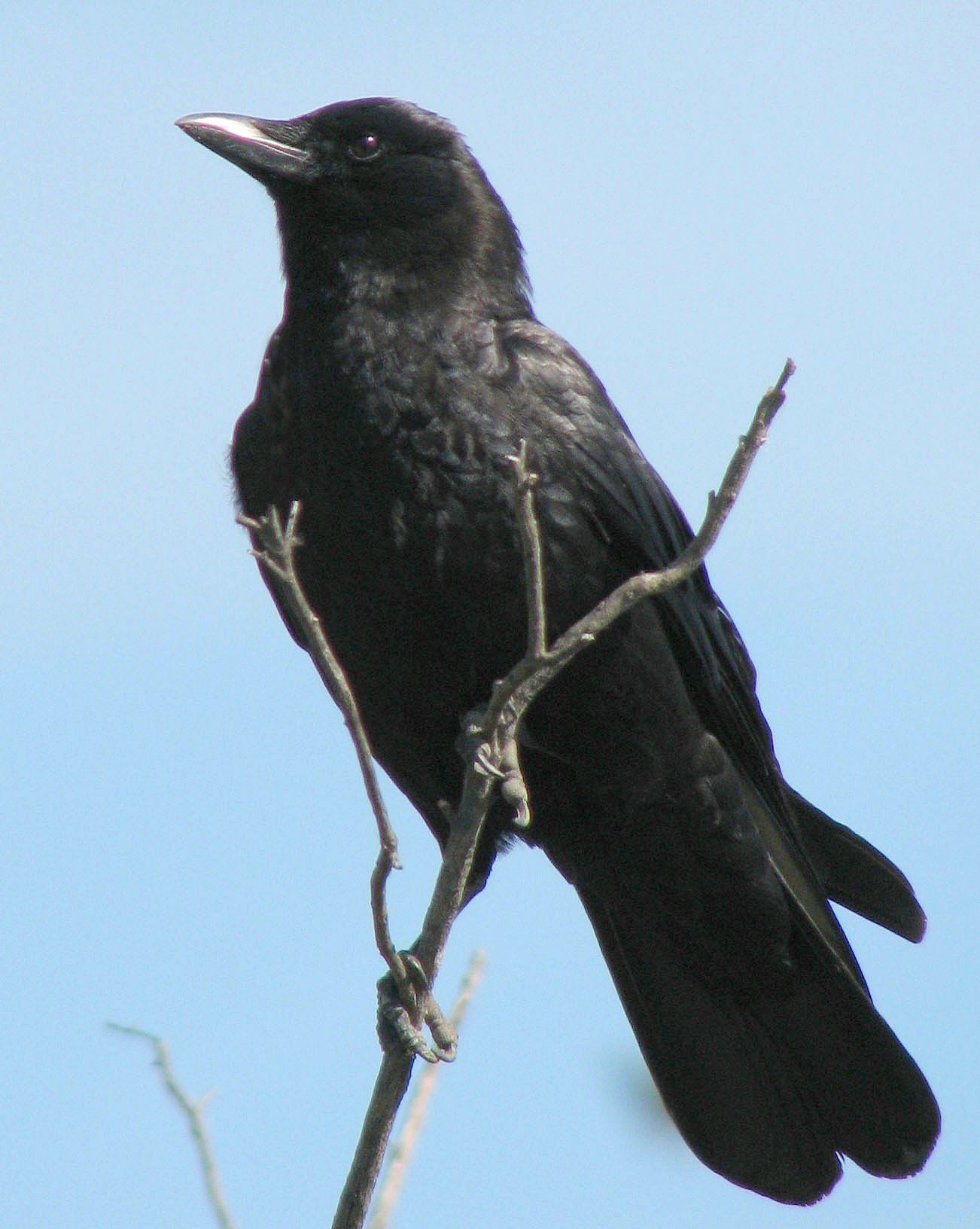
American crow is a large all-black songbird with a heavy bill, fan-shaped tail, and a strong voice that quickly becomes part of the daily soundscape. It is highly social and often appears alone, in family groups, or in noisy loose flocks depending on season and time of day.
Crows thrive in towns, agricultural edges, parks, and suburban neighborhoods because they are behaviorally flexible and willing to exploit a wide range of food sources. Lawns, garden beds, compost, street trees, utility poles, and rooftops all become part of their working landscape.
They are opportunistic omnivores, taking insects, seeds, fruit, carrion, human food scraps, and the eggs or nestlings of other birds when available. Their problem-solving ability and long memory make them especially good at navigating repeated human routines.
In garden terms, crows are not delicate visitors but active participants in the neighborhood ecology. They can annoy, entertain, clean up, raid, warn, and observe, often all within the same week.
A healthy crow presence usually indicates a landscape with enough open ground, trees, and daily ecological activity to support a generalist intelligence specialist.
Microclimate
Crows use warm rooflines, open lawns, street trees, and thermal edges created by pavement and buildings as part of a daily movement network. They favor places where visibility is high and where the transition between cover and open ground makes foraging efficient.
Neighborhood observations
In neighborhood settings, crows often know exactly which blocks produce food, water, nesting material, or conflict. They are especially noticeable in places that combine mature trees with open irrigated ground and regular human activity.