Bitter cherry Bitter cherry
Prunus emarginata
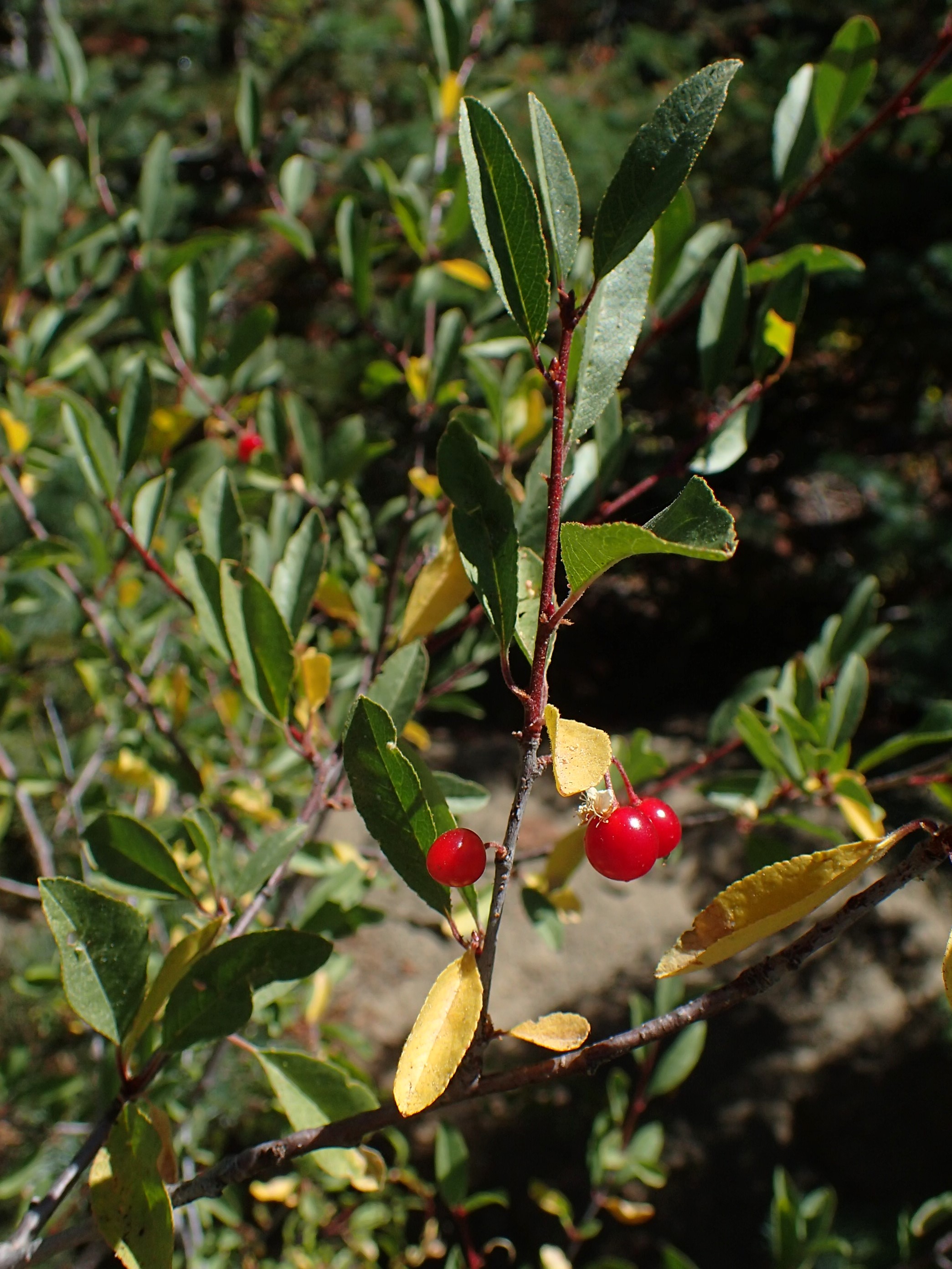
Bitter cherry is a native small tree that does its best work at the lively edge of a garden, offering spring bloom, shiny dark bark, and bright red fruit that birds value more than people do. It is not the neatest ornamental in the nursery yard, but it is one of the more honest wildlife trees we can grow on the Fairview clay. Bitter cherry is a native small tree that does its best work at the lively edge of a garden, offering spring bloom, shiny dark bark, and bright red fruit that birds value more than people do. It is not the neatest ornamental in the nursery yard, but it is one of the more honest wildlife trees we can grow on the Fairview clay.
The Native Cherry Birds Understand Immediately
Bitter cherry does not need a gardener to explain it to birds. The flowers arrive in spring, the fruit follows in summer, and robins, waxwings, and other hungry things know exactly what to do next. That direct usefulness is a big part of the tree's appeal.
For people, bitter cherry can take longer to appreciate. It is smaller and less theatrical than flowering cherry cultivars, and the fruit is more valued for habitat than for eating out of hand. The bark is dark and glossy with horizontal lenticels, the leaves are narrower than many ornamental cherries, and the overall habit can be somewhere between small tree and large thicketing shrub depending on site and management.
At The Patient Garden, that reads as an edge tree. Not a polished front-door specimen. A habitat-rich native that belongs where the garden begins to blur into hedgerow, fence line, or rougher ground.
What It Looks Like and How It Behaves
In bloom, bitter cherry carries clusters of small white flowers that have the familiar cherry look without the overload of a heavily bred ornamental. The bloom is clean, light, and useful to pollinators. Later, the fruit turns red and then darker with age. Humans often find it too bitter for fresh eating, which is how the plant got its common name, but wildlife does not hesitate.
The tree itself can be upright and fairly neat when young, then broaden and sucker over time. On some sites it holds a clearer single or few-trunk structure. On others it behaves more like a loose colony. That flexibility is ecologically helpful and aesthetically awkward if what you really wanted was a tidy patio cherry.
This is why honesty matters with native trees. Bitter cherry is not here to imitate a florist's cherry. It is here to feed things and occupy space quickly.
Why It Makes Sense on a Disturbed Site
Bitter cherry is a common pioneer or early-successional tree in western landscapes. It shows up after disturbance, along openings, and at woodland margins. That makes it a strong conceptual fit for the old Fairview site, where compacted soil, past construction, and abrupt edges still shape how the land behaves.
It is also fast enough to matter. While it is not as explosive as red alder, it establishes more quickly than some of our slower native trees and starts contributing flowers and fruit relatively early. If the goal is to build habitat value in the near term while longer-lived canopy trees are still young, bitter cherry is useful.
On the Fairview Clay
Bitter cherry is adaptable but not indifferent. On the Fairview clay, it should establish well if the planting area is loosened and mulched, but I would still avoid the wettest winter pockets. Think woodland edge or upper slope, not swampy basin.
Dig wide and set the tree at grade or a touch high if the site runs wet. A moderate amount of compost in the backfill is fine. Heavy annual mulch is even more important because it builds the top layer of soil texture that a native edge tree can exploit.
After establishment, bitter cherry can get by with limited summer water, but it responds well to a few deep irrigations in prolonged drought, especially while young. It does not want the kind of constant shallow lawn irrigation that encourages soft, disease-prone growth.
Year by Year
In the first few years, bitter cherry often looks vigorous and willing. Growth is fairly quick, and it starts to define itself early.
By years three through five, you usually know whether the plant wants to remain a cleaner small tree or start sending up more shoots from the base. If you want a more open, tree-like form, this is the stage to remove extra suckers selectively.
By year eight and beyond, the tree starts to reveal its true personality: useful, birdy, slightly unruly, and best appreciated as part of a layered planting rather than a solitary specimen on display.
Native Status and Ecology
Bitter cherry is native across much of western North America, including western Oregon. It belongs to the cherry-rich ecological world that supports pollinators, fruit-eating birds, and the insects that make bird nesting successful. Native cherries are among the more valuable woody plants for food webs because they are used at multiple life stages by multiple creatures.
That value matters in a neighborhood garden. A single native cherry may not look transformative to us, but to insects and birds it is a genuine resource pulse in both spring and summer.
Management and Tradeoffs
The tradeoff is neatness. Bitter cherry can sucker. It can host tent caterpillars or show leaf spotting in some years. It can feel more like a wild plant than a groomed ornamental. None of that means it is a bad choice. It means it should be planted where those traits read as vitality rather than failure.
If you want a formal small tree at the front walk, paperbark maple probably makes more sense. If you want habitat, spring bloom, bird fruit, and a tree that feels like it belongs to this region, bitter cherry is the better answer.
The Patient Perspective
Patient gardening is partly about learning where to stop asking one plant to do another plant's job. Bitter cherry should not be asked to behave like an imported flowering cherry bred for symmetry and spectacle. It should be asked to do what native cherries do well: settle quickly, flower lightly, feed wildlife, and make the garden edge more alive.
On the Fairview clay, that is more than enough reason to plant it.
The Native Cherry Birds Understand Immediately
Bitter cherry does not need a gardener to explain it to birds. The flowers arrive in spring, the fruit follows in summer, and robins, waxwings, and other hungry things know exactly what to do next. That direct usefulness is a big part of the tree's appeal.
For people, bitter cherry can take longer to appreciate. It is smaller and less theatrical than flowering cherry cultivars, and the fruit is more valued for habitat than for eating out of hand. The bark is dark and glossy with horizontal lenticels, the leaves are narrower than many ornamental cherries, and the overall habit can be somewhere between small tree and large thicketing shrub depending on site and management.
At The Patient Garden, that reads as an edge tree. Not a polished front-door specimen. A habitat-rich native that belongs where the garden begins to blur into hedgerow, fence line, or rougher ground.
What It Looks Like and How It Behaves
In bloom, bitter cherry carries clusters of small white flowers that have the familiar cherry look without the overload of a heavily bred ornamental. The bloom is clean, light, and useful to pollinators. Later, the fruit turns red and then darker with age. Humans often find it too bitter for fresh eating, which is how the plant got its common name, but wildlife does not hesitate.
The tree itself can be upright and fairly neat when young, then broaden and sucker over time. On some sites it holds a clearer single or few-trunk structure. On others it behaves more like a loose colony. That flexibility is ecologically helpful and aesthetically awkward if what you really wanted was a tidy patio cherry.
This is why honesty matters with native trees. Bitter cherry is not here to imitate a florist's cherry. It is here to feed things and occupy space quickly.
Why It Makes Sense on a Disturbed Site
Bitter cherry is a common pioneer or early-successional tree in western landscapes. It shows up after disturbance, along openings, and at woodland margins. That makes it a strong conceptual fit for the old Fairview site, where compacted soil, past construction, and abrupt edges still shape how the land behaves.
It is also fast enough to matter. While it is not as explosive as red alder, it establishes more quickly than some of our slower native trees and starts contributing flowers and fruit relatively early. If the goal is to build habitat value in the near term while longer-lived canopy trees are still young, bitter cherry is useful.
On the Fairview Clay
Bitter cherry is adaptable but not indifferent. On the Fairview clay, it should establish well if the planting area is loosened and mulched, but I would still avoid the wettest winter pockets. Think woodland edge or upper slope, not swampy basin.
Dig wide and set the tree at grade or a touch high if the site runs wet. A moderate amount of compost in the backfill is fine. Heavy annual mulch is even more important because it builds the top layer of soil texture that a native edge tree can exploit.
After establishment, bitter cherry can get by with limited summer water, but it responds well to a few deep irrigations in prolonged drought, especially while young. It does not want the kind of constant shallow lawn irrigation that encourages soft, disease-prone growth.
Year by Year
In the first few years, bitter cherry often looks vigorous and willing. Growth is fairly quick, and it starts to define itself early.
By years three through five, you usually know whether the plant wants to remain a cleaner small tree or start sending up more shoots from the base. If you want a more open, tree-like form, this is the stage to remove extra suckers selectively.
By year eight and beyond, the tree starts to reveal its true personality: useful, birdy, slightly unruly, and best appreciated as part of a layered planting rather than a solitary specimen on display.
Native Status and Ecology
Bitter cherry is native across much of western North America, including western Oregon. It belongs to the cherry-rich ecological world that supports pollinators, fruit-eating birds, and the insects that make bird nesting successful. Native cherries are among the more valuable woody plants for food webs because they are used at multiple life stages by multiple creatures.
That value matters in a neighborhood garden. A single native cherry may not look transformative to us, but to insects and birds it is a genuine resource pulse in both spring and summer.
Management and Tradeoffs
The tradeoff is neatness. Bitter cherry can sucker. It can host tent caterpillars or show leaf spotting in some years. It can feel more like a wild plant than a groomed ornamental. None of that means it is a bad choice. It means it should be planted where those traits read as vitality rather than failure.
If you want a formal small tree at the front walk, paperbark maple probably makes more sense. If you want habitat, spring bloom, bird fruit, and a tree that feels like it belongs to this region, bitter cherry is the better answer.
The Patient Perspective
Patient gardening is partly about learning where to stop asking one plant to do another plant's job. Bitter cherry should not be asked to behave like an imported flowering cherry bred for symmetry and spectacle. It should be asked to do what native cherries do well: settle quickly, flower lightly, feed wildlife, and make the garden edge more alive.
On the Fairview clay, that is more than enough reason to plant it.
Continue Continuar