Oregon myrtle / California bay Oregon myrtle / California bay
Umbellularia californica
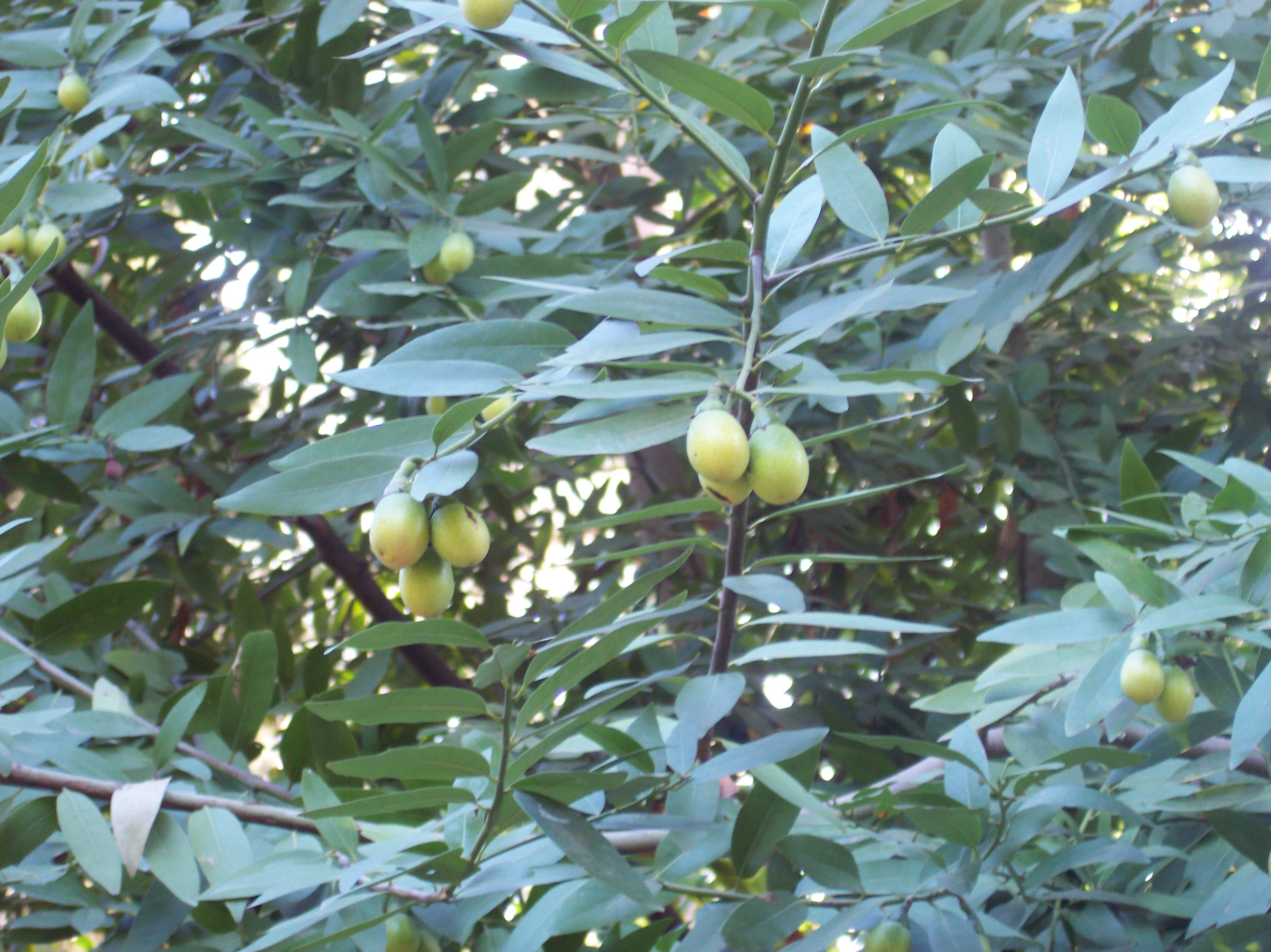
Oregon myrtle, also called California bay, is a handsome evergreen tree with aromatic leaves, small spring flowers, and olive-like fruit that keeps the canopy useful in every month of the year. It is more adaptable than madrone on our heavy ground, but it still wants drainage, room, and a gardener who understands that this can become a real tree, not just a clipped evergreen accent. Oregon myrtle, also called California bay, is a handsome evergreen tree with aromatic leaves, small spring flowers, and olive-like fruit that keeps the canopy useful in every month of the year. It is more adaptable than madrone on our heavy ground, but it still wants drainage, room, and a gardener who understands that this can become a real tree, not just a clipped evergreen accent.
The Tree You Smell Before You Name
Oregon myrtle is one of those trees that announces itself before a label ever does. Crush a leaf and the scent rises immediately: spicy, resinous, bay-like, and stronger than the culinary bay leaves most cooks keep in the pantry. That fragrance, paired with glossy evergreen leaves and a dense, rounded canopy, gives the tree a distinctive West Coast presence that feels both wild and cultivated.
The name depends on where you stand. In southwestern Oregon it is often Oregon myrtle. In California it is usually California bay or California laurel. Botanically it is Umbellularia californica, a native evergreen of coastal forests, stream corridors, and lower mountain slopes. In Salem it is not a common street tree, but it is a very usable one if you have the space and do not mind a plant with some seriousness to it.
What It Brings to a Garden
Oregon myrtle gives structure first. The leaves are narrow, leathery, and deep green, and they hold well through winter storms and summer drought. The flowers are small and yellow-green, more interesting than showy, and they open in late winter to spring when we are paying close attention to any sign that the season is turning. Later in the year the tree produces olive-like drupes that shift from green to purple.
The overall effect is calm and substantial. This is not an ornamental tree planted for a two-week show. It is a tree planted to anchor space, hold an evergreen edge, and give a garden an older feeling over time.
If left alone, Oregon myrtle can become a medium to large tree. In tighter gardens it is often thinned and lifted to show the trunk structure, or kept multi-stemmed as a broad screen. That flexibility is part of its appeal. It can read as woodland tree, patio shade, or evergreen backdrop depending on how it is trained.
The Honest Size Conversation
The main mistake with Oregon myrtle is underestimating it. Young plants look so manageable that it is easy to tuck one too near a fence, walk, or foundation. Over time the crown thickens and widens. On richer sites near the coast it can become a truly large tree. Inland, in Salem, growth is usually more restrained, but it still deserves respect.
The second mistake is assuming it wants the same treatment as an English laurel hedge or a foundation shrub. It does not. This is not a plant for relentless shearing. It responds better to thoughtful thinning and structural pruning done occasionally, then left alone.
On the Fairview Clay
Oregon myrtle is more forgiving on heavy soil than many western evergreens, but it still prefers drainage over winter saturation. On the Fairview clay, I would treat it as a tree for the better-drained middle ground: not the wettest basin, not the hardest baked strip, but a place where winter water can move and the root zone can breathe.
Dig wide, not deep. Blend only modest compost into the backfill and use mulch to improve soil over time. If the site tends to puddle, raise the planting area slightly. Once rooted, the tree handles our dry summers well, but it benefits from deep watering during establishment and in prolonged heat during its early years.
It also appreciates shelter from the coldest east wind. Salem winters are not extreme, but a site with some protection from desiccating wind helps the foliage look better and reduces winter stress.
Year by Year
In the first two or three years, Oregon myrtle usually grows steadily rather than dramatically. It is not a red alder. It settles, thickens, and puts energy into root establishment.
By year five, you start to see what form it wants. Some specimens push into a clear central leader and broad crown. Others naturally hold a multi-stem habit. This is the right stage to decide whether you want a lifted tree form or a lower, screening presence.
By year ten, a well-sited tree begins to carry real evergreen weight in the garden. That matters in Salem, where winter structure can make the difference between a landscape that disappears and one that still feels composed in January.
Wildlife and Human Use
The flowers offer modest early forage for insects, and the fruits are taken by birds and small mammals. Dense evergreen branching provides cover for nesting and winter shelter. Wildlife value is not as towering as an oak or native cherry, but it is real.
The leaves also have a long human history. They have been used as seasoning and as a strongly aromatic household plant, though the flavor is much more potent than Mediterranean bay and needs a careful hand. Indigenous communities and later settlers both found uses for the tree. That cultural familiarity adds another layer of interest.
Native Status and Fit Here
Oregon myrtle is native to southwestern Oregon and California, not to the Salem valley floor specifically. That distinction matters. It is a regional native rather than a local Willamette Valley tree. Still, it belongs to the flora of the broader West Coast and feels much more grounded here than a generic evergreen imported from another continent.
At The Patient Garden, I think of Oregon myrtle as a useful bridge tree: evergreen, western, aromatic, and practical. If you want a broadleaf evergreen that feels regional instead of generic, this is one of the best candidates.
The Patient Perspective
Oregon myrtle rewards gardeners who think in layers rather than moments. Its flowers are quiet. Its foliage is steady. Its fragrance is discovered, not broadcast. Over the years the crown densifies, the trunk gains character, and the tree becomes the background that makes other plants look better.
That is patient-garden value. Not everything in the landscape needs to be the loudest thing in bloom. Some trees are there to hold the space, season after season, and Oregon myrtle does that beautifully.
The Tree You Smell Before You Name
Oregon myrtle is one of those trees that announces itself before a label ever does. Crush a leaf and the scent rises immediately: spicy, resinous, bay-like, and stronger than the culinary bay leaves most cooks keep in the pantry. That fragrance, paired with glossy evergreen leaves and a dense, rounded canopy, gives the tree a distinctive West Coast presence that feels both wild and cultivated.
The name depends on where you stand. In southwestern Oregon it is often Oregon myrtle. In California it is usually California bay or California laurel. Botanically it is Umbellularia californica, a native evergreen of coastal forests, stream corridors, and lower mountain slopes. In Salem it is not a common street tree, but it is a very usable one if you have the space and do not mind a plant with some seriousness to it.
What It Brings to a Garden
Oregon myrtle gives structure first. The leaves are narrow, leathery, and deep green, and they hold well through winter storms and summer drought. The flowers are small and yellow-green, more interesting than showy, and they open in late winter to spring when we are paying close attention to any sign that the season is turning. Later in the year the tree produces olive-like drupes that shift from green to purple.
The overall effect is calm and substantial. This is not an ornamental tree planted for a two-week show. It is a tree planted to anchor space, hold an evergreen edge, and give a garden an older feeling over time.
If left alone, Oregon myrtle can become a medium to large tree. In tighter gardens it is often thinned and lifted to show the trunk structure, or kept multi-stemmed as a broad screen. That flexibility is part of its appeal. It can read as woodland tree, patio shade, or evergreen backdrop depending on how it is trained.
The Honest Size Conversation
The main mistake with Oregon myrtle is underestimating it. Young plants look so manageable that it is easy to tuck one too near a fence, walk, or foundation. Over time the crown thickens and widens. On richer sites near the coast it can become a truly large tree. Inland, in Salem, growth is usually more restrained, but it still deserves respect.
The second mistake is assuming it wants the same treatment as an English laurel hedge or a foundation shrub. It does not. This is not a plant for relentless shearing. It responds better to thoughtful thinning and structural pruning done occasionally, then left alone.
On the Fairview Clay
Oregon myrtle is more forgiving on heavy soil than many western evergreens, but it still prefers drainage over winter saturation. On the Fairview clay, I would treat it as a tree for the better-drained middle ground: not the wettest basin, not the hardest baked strip, but a place where winter water can move and the root zone can breathe.
Dig wide, not deep. Blend only modest compost into the backfill and use mulch to improve soil over time. If the site tends to puddle, raise the planting area slightly. Once rooted, the tree handles our dry summers well, but it benefits from deep watering during establishment and in prolonged heat during its early years.
It also appreciates shelter from the coldest east wind. Salem winters are not extreme, but a site with some protection from desiccating wind helps the foliage look better and reduces winter stress.
Year by Year
In the first two or three years, Oregon myrtle usually grows steadily rather than dramatically. It is not a red alder. It settles, thickens, and puts energy into root establishment.
By year five, you start to see what form it wants. Some specimens push into a clear central leader and broad crown. Others naturally hold a multi-stem habit. This is the right stage to decide whether you want a lifted tree form or a lower, screening presence.
By year ten, a well-sited tree begins to carry real evergreen weight in the garden. That matters in Salem, where winter structure can make the difference between a landscape that disappears and one that still feels composed in January.
Wildlife and Human Use
The flowers offer modest early forage for insects, and the fruits are taken by birds and small mammals. Dense evergreen branching provides cover for nesting and winter shelter. Wildlife value is not as towering as an oak or native cherry, but it is real.
The leaves also have a long human history. They have been used as seasoning and as a strongly aromatic household plant, though the flavor is much more potent than Mediterranean bay and needs a careful hand. Indigenous communities and later settlers both found uses for the tree. That cultural familiarity adds another layer of interest.
Native Status and Fit Here
Oregon myrtle is native to southwestern Oregon and California, not to the Salem valley floor specifically. That distinction matters. It is a regional native rather than a local Willamette Valley tree. Still, it belongs to the flora of the broader West Coast and feels much more grounded here than a generic evergreen imported from another continent.
At The Patient Garden, I think of Oregon myrtle as a useful bridge tree: evergreen, western, aromatic, and practical. If you want a broadleaf evergreen that feels regional instead of generic, this is one of the best candidates.
The Patient Perspective
Oregon myrtle rewards gardeners who think in layers rather than moments. Its flowers are quiet. Its foliage is steady. Its fragrance is discovered, not broadcast. Over the years the crown densifies, the trunk gains character, and the tree becomes the background that makes other plants look better.
That is patient-garden value. Not everything in the landscape needs to be the loudest thing in bloom. Some trees are there to hold the space, season after season, and Oregon myrtle does that beautifully.
Continue Continuar