Pacific madrone Pacific madrone
Arbutus menziesii
Pacific madrone is the West Coast's great broadleaf evergreen, with smooth red bark, white urn-shaped flowers, and orange-red berries that make it look alive in every season. It is also one of the most exacting native trees we could try on the Fairview clay, rewarding sharp drainage, open sun, and a lighter hand than most gardeners first think to give. Pacific madrone is the West Coast's great broadleaf evergreen, with smooth red bark, white urn-shaped flowers, and orange-red berries that make it look alive in every season. It is also one of the most exacting native trees we could try on the Fairview clay, rewarding sharp drainage, open sun, and a lighter hand than most gardeners first think to give.
The Tree People Stop For
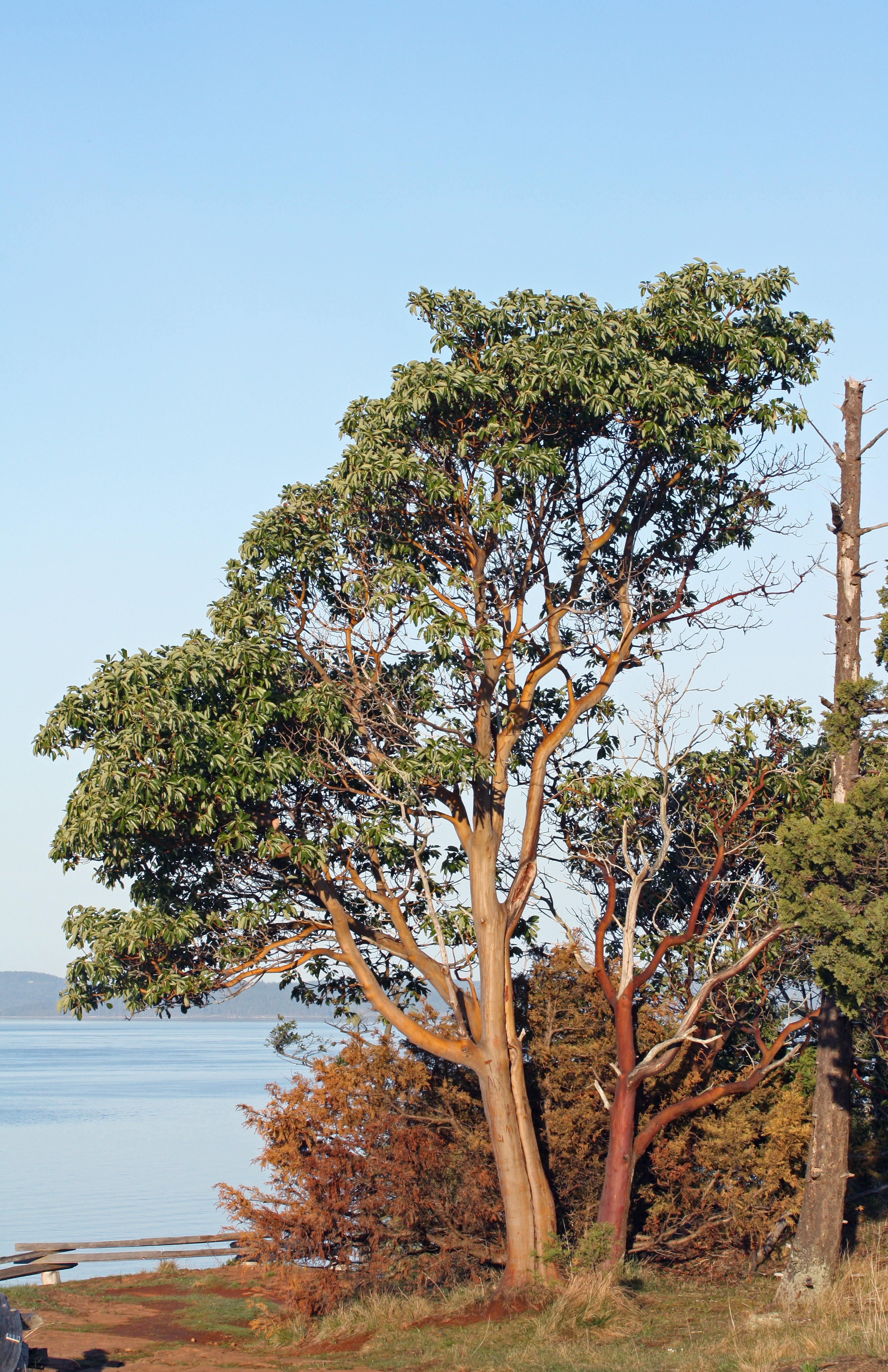
Pacific madrone has the kind of bark that makes strangers slow down. On a dry summer afternoon it glows cinnamon, copper, and soft orange, with older skin curling away in papery sheets to reveal the fresh surface beneath. Add the glossy evergreen leaves, the clusters of white bell-like flowers, and the orange-red berries that hang into fall, and you get a tree that looks finished every month of the year.
That beauty is part of why madrone carries so much emotional weight in western Oregon. It reads as wild coast range, dry hillside, and open sky all at once. At The Patient Garden, madrone represents the native tree many of us want before we have really earned it. It asks for less fuss than we assume, but it asks for the right conditions from the start.
What Makes Madrone Different
Most of our native valley trees are either deciduous broadleaf trees or evergreen conifers. Pacific madrone occupies a rarer middle ground: an evergreen broadleaf tree of dry slopes, rocky ridges, and well-drained woodland edges from British Columbia south into California. It keeps a broadleaf softness in the canopy while still giving year-round structure.
The leaves are leathery, dark green above, and paler beneath, usually four to six inches long. In late spring and early summer the tree carries dangling clusters of small white flowers that look a little like oversized blueberry bloom. By late summer and fall those flowers have become knobby orange-red fruit. Birds take them readily, and the color against the bark is one of the best fall combinations in any Pacific Northwest tree.
Madrone also ages beautifully. Young trees can be narrow and upright. Older specimens broaden into irregular crowns with twisting limbs and real personality. This is not a clipped or symmetrical tree. It is a tree that grows into character.
The Hard Part
Here is the honest part early: madrone is easy to admire and harder to establish than most native trees sold for home landscapes. The problem is not cold. Salem is well within its hardiness range. The problem is drainage, root disturbance, and summer irrigation habits that suit lawns better than madrones.
Pacific madrone dislikes being moved once it has started building its root system. It wants to send roots deep and settle in. Nursery stock in small containers usually establishes better than large, overgrown specimens because the root system has been disturbed less. Once planted, madrone wants stability. Re-digging, heavy cultivation around the root zone, and frequent shallow watering all work against it.
It also hates winter saturation. In the wild, madrone often grows where water moves away quickly through gravel, fractured rock, or sloping mineral soil. On the Fairview clay, winter water is exactly the thing we have too much of. That means success with madrone depends less on pampering and more on siting.
On the Fairview Clay
If we plant madrone here, we need to plant for drainage first and everything else second. Choose the highest, driest place available. A south- or west-facing slope, berm, or raised planting area is ideal. If the site is flat, build a broad mound rather than a deep amended hole. A hole full of rich soil inside a basin of clay simply creates a bathtub.
Use the native soil, but open it with pumice, crushed gravel, or very coarse mineral amendment. Compost should be light, not dominant. The goal is not fertility. The goal is oxygen around the roots in winter. Set the root flare slightly above grade, mulch lightly, and keep the mulch back from the trunk.
After planting, water deeply but sparingly through the first two summers. Then back off. Mature madrones on valley and foothill sites live without summer irrigation. The more the tree learns to chase moisture downward, the better it will handle Salem's dry season.
Year by Year
Year one often looks quieter than gardeners expect. Madrone may hold, not surge. That is normal. It is investing in roots.
Years two and three are when the tree begins to tell the truth about the site. If drainage is wrong, decline shows up as dull foliage, dieback, or slow collapse. If the siting is right, growth gradually steadies and the crown begins to fill.
By year five, a well-sited madrone starts to look settled. The bark develops richer color, the crown becomes denser, and the tree begins to read as a permanent part of the landscape rather than a careful experiment. Older trees become sculptural in a way few young specimens hint at.
Wildlife Value
Pacific madrone is excellent habitat. The flowers draw bees and other pollinators in late spring. The fruit feeds robins, waxwings, band-tailed pigeons, and other birds. The evergreen canopy gives cover in winter, and mature bark supports insects, lichens, and mosses.
Ecologically, madrone matters because it occupies the dry-edge niche between forest and open slope. It is part of the mixed woodland structure that supports a lot of life, especially where conifers, oaks, and madrone overlap. A mature madrone is not just a pretty tree. It is a habitat tree with real regional identity.
Why It Is Worth Trying
Pacific madrone is not the native tree I would hand to a beginner on heavy clay. Oregon white oak, red alder, and even cascara are more forgiving. But if you have the right dry spot and the discipline not to overwater, madrone gives something no other local tree gives in the same way: broadleaf evergreen structure, beautiful bark, native habitat value, and the feeling that the coastal hills somehow reached into Salem.
The patient gardener's lesson with madrone is restraint. Do less. Disturb the roots less. Amend less. Water less often. Worry less when the first years are quiet. When the site is right, the tree already knows what to do.
The Tree People Stop For
Pacific madrone has the kind of bark that makes strangers slow down. On a dry summer afternoon it glows cinnamon, copper, and soft orange, with older skin curling away in papery sheets to reveal the fresh surface beneath. Add the glossy evergreen leaves, the clusters of white bell-like flowers, and the orange-red berries that hang into fall, and you get a tree that looks finished every month of the year.
That beauty is part of why madrone carries so much emotional weight in western Oregon. It reads as wild coast range, dry hillside, and open sky all at once. At The Patient Garden, madrone represents the native tree many of us want before we have really earned it. It asks for less fuss than we assume, but it asks for the right conditions from the start.
What Makes Madrone Different
Most of our native valley trees are either deciduous broadleaf trees or evergreen conifers. Pacific madrone occupies a rarer middle ground: an evergreen broadleaf tree of dry slopes, rocky ridges, and well-drained woodland edges from British Columbia south into California. It keeps a broadleaf softness in the canopy while still giving year-round structure.
The leaves are leathery, dark green above, and paler beneath, usually four to six inches long. In late spring and early summer the tree carries dangling clusters of small white flowers that look a little like oversized blueberry bloom. By late summer and fall those flowers have become knobby orange-red fruit. Birds take them readily, and the color against the bark is one of the best fall combinations in any Pacific Northwest tree.
Madrone also ages beautifully. Young trees can be narrow and upright. Older specimens broaden into irregular crowns with twisting limbs and real personality. This is not a clipped or symmetrical tree. It is a tree that grows into character.
The Hard Part
Here is the honest part early: madrone is easy to admire and harder to establish than most native trees sold for home landscapes. The problem is not cold. Salem is well within its hardiness range. The problem is drainage, root disturbance, and summer irrigation habits that suit lawns better than madrones.
Pacific madrone dislikes being moved once it has started building its root system. It wants to send roots deep and settle in. Nursery stock in small containers usually establishes better than large, overgrown specimens because the root system has been disturbed less. Once planted, madrone wants stability. Re-digging, heavy cultivation around the root zone, and frequent shallow watering all work against it.
It also hates winter saturation. In the wild, madrone often grows where water moves away quickly through gravel, fractured rock, or sloping mineral soil. On the Fairview clay, winter water is exactly the thing we have too much of. That means success with madrone depends less on pampering and more on siting.
On the Fairview Clay
If we plant madrone here, we need to plant for drainage first and everything else second. Choose the highest, driest place available. A south- or west-facing slope, berm, or raised planting area is ideal. If the site is flat, build a broad mound rather than a deep amended hole. A hole full of rich soil inside a basin of clay simply creates a bathtub.
Use the native soil, but open it with pumice, crushed gravel, or very coarse mineral amendment. Compost should be light, not dominant. The goal is not fertility. The goal is oxygen around the roots in winter. Set the root flare slightly above grade, mulch lightly, and keep the mulch back from the trunk.
After planting, water deeply but sparingly through the first two summers. Then back off. Mature madrones on valley and foothill sites live without summer irrigation. The more the tree learns to chase moisture downward, the better it will handle Salem's dry season.
Year by Year
Year one often looks quieter than gardeners expect. Madrone may hold, not surge. That is normal. It is investing in roots.
Years two and three are when the tree begins to tell the truth about the site. If drainage is wrong, decline shows up as dull foliage, dieback, or slow collapse. If the siting is right, growth gradually steadies and the crown begins to fill.
By year five, a well-sited madrone starts to look settled. The bark develops richer color, the crown becomes denser, and the tree begins to read as a permanent part of the landscape rather than a careful experiment. Older trees become sculptural in a way few young specimens hint at.
Wildlife Value
Pacific madrone is excellent habitat. The flowers draw bees and other pollinators in late spring. The fruit feeds robins, waxwings, band-tailed pigeons, and other birds. The evergreen canopy gives cover in winter, and mature bark supports insects, lichens, and mosses.
Ecologically, madrone matters because it occupies the dry-edge niche between forest and open slope. It is part of the mixed woodland structure that supports a lot of life, especially where conifers, oaks, and madrone overlap. A mature madrone is not just a pretty tree. It is a habitat tree with real regional identity.
Why It Is Worth Trying
Pacific madrone is not the native tree I would hand to a beginner on heavy clay. Oregon white oak, red alder, and even cascara are more forgiving. But if you have the right dry spot and the discipline not to overwater, madrone gives something no other local tree gives in the same way: broadleaf evergreen structure, beautiful bark, native habitat value, and the feeling that the coastal hills somehow reached into Salem.
The patient gardener's lesson with madrone is restraint. Do less. Disturb the roots less. Amend less. Water less often. Worry less when the first years are quiet. When the site is right, the tree already knows what to do.
Continue Continuar