Dragonflies Dragonflies
Anisoptera
Dragonflies are the aerial hunters of warm weather, turning open air above water, paths, and garden edges into a patrol route. Around the old Fairview site, they are one of the clearest signs that nearby wet habitat is still feeding the wider summer landscape. Dragonflies are the aerial hunters of warm weather, turning open air above water, paths, and garden edges into a patrol route. Around the old Fairview site, they are one of the clearest signs that nearby wet habitat is still feeding the wider summer landscape.
The Patrol Over the Warm Ground
A dragonfly does not meander through a garden the way a butterfly does. It patrols. It owns a lane of air for a few seconds, then another, pivoting hard, braking, and accelerating with an ease that makes most other flying insects look improvised. On hot summer days around the old Fairview site, that kind of flight brings a welcome feeling of control to the air. Something is clearly in charge of the mosquitoes.
Dragonflies are among the most satisfying warm-season wildlife to watch because their behavior is so readable even from a distance. They hunt. They perch. They launch. Then they do it again.
Not Just Pond Insects
Dragonflies begin life in water, but the adults range widely. That matters in a neighborhood setting. You do not need a large ornamental pond in The Patient Garden itself to enjoy dragonflies overhead. If there are ditches, wetlands, creeks, retention basins, seasonal ponds, or other breeding waters in the broader landscape, adults can patrol gardens, open ground, and path edges far beyond the emergence site.
The old Fairview site sits in exactly the kind of mixed landscape where that wider movement makes sense. Wet pockets, drainage infrastructure, nearby water bodies, and open sunny foraging space all work together. A dragonfly over the garden may have hatched close by or may simply be using the site as excellent hunting airspace.
Identification
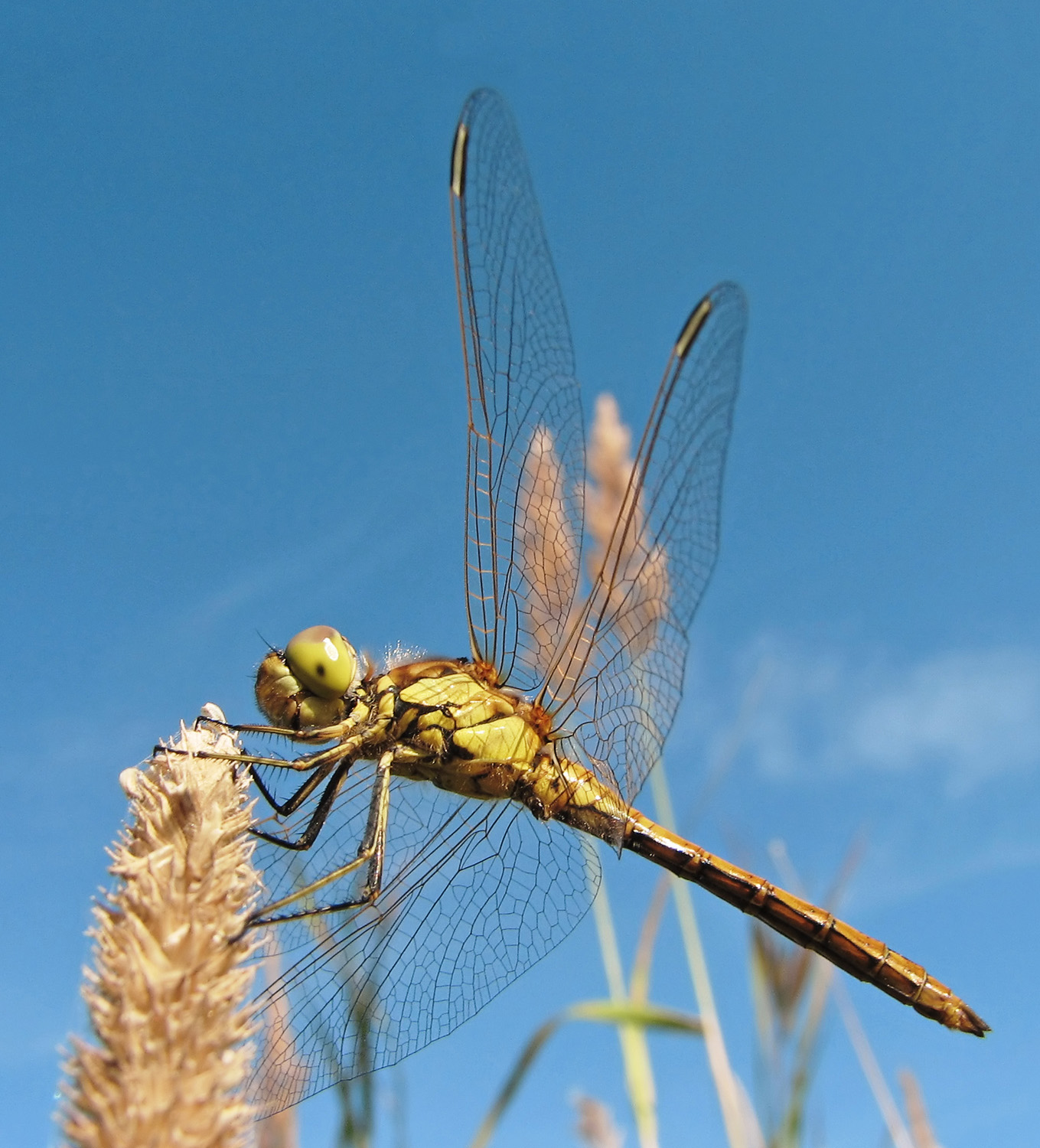
Dragonflies are the larger, sturdier branch of the dragonfly-damselfly world. They hold their wings out to the side at rest, have broad eyes that take up much of the head, and fly with power and control rather than a delicate flutter. Color varies enormously by species. Blues, greens, reds, browns, amber wings, powdery bloom on the abdomen, and metallic highlights all show up depending on who is flying.
At the field-guide level, the useful first distinction is shape and behavior. Strong-bodied. Broad-eyed. Wings held out. Fast and capable of hovering or reversing quickly.
Around The Patient Garden
Dragonflies use The Patient Garden as feeding territory and occasional perching ground. Bamboo stakes, wire supports, shrub tips, and sunlit twig ends all serve as launch points. Open patches between beds or along paths become hunting lanes. They especially like the kind of summer airspace where small flies, gnats, and mosquitoes gather in loose swarms.
The Fairview clay has a subtle role here. Where low spots hold moisture longer or irrigation creates humid edges, insect density rises. Those patches can attract feeding dragonflies even when the actual breeding water is elsewhere. In this way the garden participates in the dragonfly story without needing to be a pond.
Predators Twice Over
Dragonflies are predators as larvae and as adults. Aquatic larvae eat other aquatic life, including mosquito larvae and small invertebrates. Adults take flying insects on the wing. That double predatory life cycle is part of why healthy dragonfly populations usually signal functioning wet habitat plus decent-quality surrounding terrestrial hunting space.
If you see regular dragonfly patrols through summer, the neighborhood has enough water somewhere and enough insect production somewhere else to keep them working. That is a useful ecological clue.
Seasonal Rhythm
In Salem, dragonfly activity is mostly a warm-season story. Late spring starts it, summer intensifies it, and early fall often extends it longer than people expect. Hot calm afternoons are classic dragonfly weather, especially where sun, water, and open ground overlap.
Perching behavior often becomes easier to watch in mid-morning and again late in the day, when territorial flights alternate with longer rests. Some species patrol continuously. Others make short flights and return to the same perch again and again.
Conservation and What They Tell Us
Dragonflies are not a single conservation story because the group is broad, but at neighborhood scale their needs are clear enough: water that can support larvae, vegetation around wet edges, and reduced pesticide contamination in both water and surrounding terrestrial habitat.
That makes them useful indicators around the old Fairview site. If dragonflies still patrol there through the warm months, then nearby wet habitat is still doing something right. The adults carry that evidence into the garden air.
They also offer one of the simplest forms of summer delight. A dragonfly on a stake at the edge of the bed is a machine built beautifully enough not to feel mechanical. It belongs to the hot bright hours of the season, and the garden feels sharper once you notice it.
The Patrol Over the Warm Ground
A dragonfly does not meander through a garden the way a butterfly does. It patrols. It owns a lane of air for a few seconds, then another, pivoting hard, braking, and accelerating with an ease that makes most other flying insects look improvised. On hot summer days around the old Fairview site, that kind of flight brings a welcome feeling of control to the air. Something is clearly in charge of the mosquitoes.
Dragonflies are among the most satisfying warm-season wildlife to watch because their behavior is so readable even from a distance. They hunt. They perch. They launch. Then they do it again.
Not Just Pond Insects
Dragonflies begin life in water, but the adults range widely. That matters in a neighborhood setting. You do not need a large ornamental pond in The Patient Garden itself to enjoy dragonflies overhead. If there are ditches, wetlands, creeks, retention basins, seasonal ponds, or other breeding waters in the broader landscape, adults can patrol gardens, open ground, and path edges far beyond the emergence site.
The old Fairview site sits in exactly the kind of mixed landscape where that wider movement makes sense. Wet pockets, drainage infrastructure, nearby water bodies, and open sunny foraging space all work together. A dragonfly over the garden may have hatched close by or may simply be using the site as excellent hunting airspace.
Identification
Dragonflies are the larger, sturdier branch of the dragonfly-damselfly world. They hold their wings out to the side at rest, have broad eyes that take up much of the head, and fly with power and control rather than a delicate flutter. Color varies enormously by species. Blues, greens, reds, browns, amber wings, powdery bloom on the abdomen, and metallic highlights all show up depending on who is flying.
At the field-guide level, the useful first distinction is shape and behavior. Strong-bodied. Broad-eyed. Wings held out. Fast and capable of hovering or reversing quickly.
Around The Patient Garden
Dragonflies use The Patient Garden as feeding territory and occasional perching ground. Bamboo stakes, wire supports, shrub tips, and sunlit twig ends all serve as launch points. Open patches between beds or along paths become hunting lanes. They especially like the kind of summer airspace where small flies, gnats, and mosquitoes gather in loose swarms.
The Fairview clay has a subtle role here. Where low spots hold moisture longer or irrigation creates humid edges, insect density rises. Those patches can attract feeding dragonflies even when the actual breeding water is elsewhere. In this way the garden participates in the dragonfly story without needing to be a pond.
Predators Twice Over
Dragonflies are predators as larvae and as adults. Aquatic larvae eat other aquatic life, including mosquito larvae and small invertebrates. Adults take flying insects on the wing. That double predatory life cycle is part of why healthy dragonfly populations usually signal functioning wet habitat plus decent-quality surrounding terrestrial hunting space.
If you see regular dragonfly patrols through summer, the neighborhood has enough water somewhere and enough insect production somewhere else to keep them working. That is a useful ecological clue.
Seasonal Rhythm
In Salem, dragonfly activity is mostly a warm-season story. Late spring starts it, summer intensifies it, and early fall often extends it longer than people expect. Hot calm afternoons are classic dragonfly weather, especially where sun, water, and open ground overlap.
Perching behavior often becomes easier to watch in mid-morning and again late in the day, when territorial flights alternate with longer rests. Some species patrol continuously. Others make short flights and return to the same perch again and again.
Conservation and What They Tell Us
Dragonflies are not a single conservation story because the group is broad, but at neighborhood scale their needs are clear enough: water that can support larvae, vegetation around wet edges, and reduced pesticide contamination in both water and surrounding terrestrial habitat.
That makes them useful indicators around the old Fairview site. If dragonflies still patrol there through the warm months, then nearby wet habitat is still doing something right. The adults carry that evidence into the garden air.
They also offer one of the simplest forms of summer delight. A dragonfly on a stake at the edge of the bed is a machine built beautifully enough not to feel mechanical. It belongs to the hot bright hours of the season, and the garden feels sharper once you notice it.
Continue Continuar