American robin American robin
Turdus migratorius
The American robin is THE neighborhood bird — the one everyone recognizes, the one pulling worms from the lawn on a spring morning, the one whose clear, caroling song defines the soundtrack of Salem from February through July. Year-round on the Fairview grounds, robins are so familiar they're easy to take for granted. The American robin is THE neighborhood bird — the one everyone recognizes, the one pulling worms from the lawn on a spring morning, the one whose clear, caroling song defines the soundtrack of Salem from February through July. Year-round on the Fairview grounds, robins are so familiar they're easy to take for granted.
The Bird Everyone Knows
Ask anyone in Salem to name a bird, and odds are good they'll say "robin." The American robin is the default bird — the one that shows up on the lawn before the coffee's ready, the one whose song carries through the neighborhood at dawn and dusk, the one that kids learn to identify before they can ride a bike. Robins are so common and so familiar that we forget to actually look at them. That's a mistake, because a robin in good light is a handsome bird, and their behavior is more interesting than their ubiquity suggests.
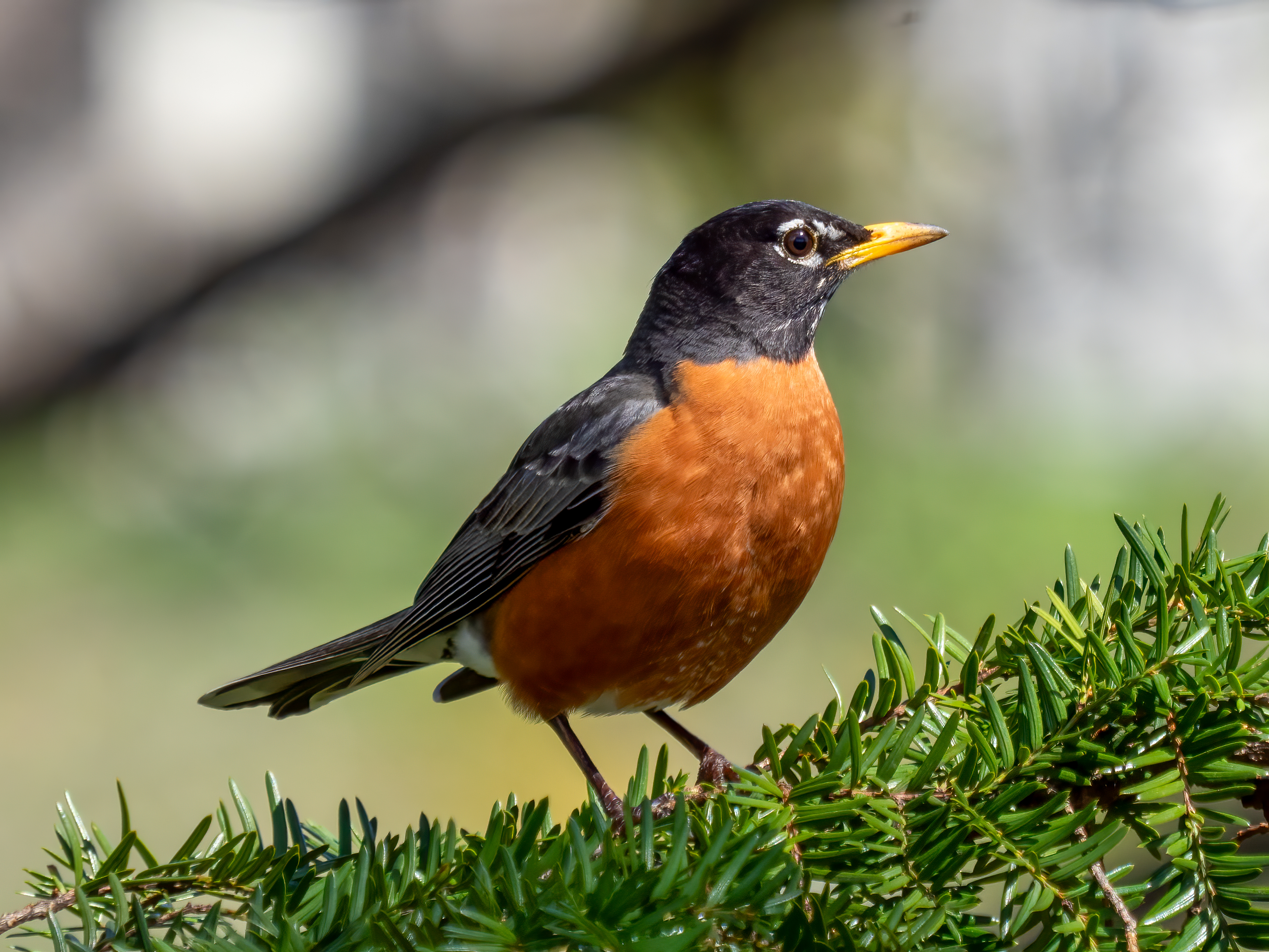
American robins are thrushes — members of the same family as bluebirds, hermit thrushes, and the famous nightingales of Europe. They're about ten inches long with a slate-gray back, a brick-orange breast, a white eye ring, and a yellow bill. Males are more richly colored than females, with a darker head and more vivid breast, but the differences are subtle. In flight, the white corners of the tail flash conspicuously.
The Lawn Forager
The image of a robin on a lawn is so iconic it barely needs describing, but the behavior itself is worth watching closely. Robins hunt earthworms by sight — not by hearing, despite the popular myth. The bird runs a few steps across the grass, stops, tilts its head to one side, and stares at the ground. That head-tilt is the bird positioning one eye for the best angle to detect movement beneath the grass surface. When a worm is spotted, the robin makes a quick lunge and pulls it free.
This foraging technique requires short, open grass — which is why robins are so closely associated with lawns, playing fields, and mowed areas. But they're not lawn specialists in the way people assume. Robins also forage in leaf litter under trees, along garden bed edges, in mulched areas, and through meadows. And their diet shifts dramatically with the seasons.
In spring and summer, earthworms and insects dominate — caterpillars, beetles, grubs, and whatever else they can find in the soil and on low vegetation. By late summer and especially through fall and winter, the diet swings to fruit: crabapples, hawthorn berries, juniper berries, holly berries, toyon, and any other persistent fruit they can find. Winter robins form large flocks that move through the landscape stripping berry-bearing trees. It's a completely different bird from the solitary lawn hunter of spring.
Year-Round but Changing
Robins are present in Salem year-round, but the population isn't static. Many of the breeding birds that nest in your yard during spring and summer migrate south for winter, replaced by robins from farther north — Alaska, British Columbia, the interior Northwest. So the robin on your lawn in January may not be the same individual as the one in June. The winter birds are often in larger flocks and more oriented toward fruiting trees than lawns.
Breeding season runs from March through July, with most nesting starting in April. Robins are among the earliest nesters in the neighborhood — you'll see them carrying nesting material while many other songbirds are still sorting out territories. The nest is a solid mud-and-grass cup, typically built on a horizontal branch or ledge four to fifteen feet up. Trees, porch eaves, light fixtures, and rain gutters are all fair game. Three to five blue eggs are iconic — "robin's egg blue" is named for exactly this shade. Pairs typically raise two broods per season.
Around The Patient Garden
Robins are everywhere on the old Fairview Training Center grounds. The mix of open lawns, garden beds, mature trees, and surrounding edges is textbook robin habitat. You'll see them foraging on any patch of open ground — the garden pathways, the lawn areas, the mulched beds after watering. They nest in the ornamental and native trees on the property and sing from the highest available perches at dawn and dusk.
The heavy clay soil of the Fairview site actually supports good earthworm populations once the surface layer is amended and kept moist. The garden beds at The Patient Garden, with their compost-improved topsoil and regular watering, are prime worm-hunting territory for robins. Early morning, especially after overnight moisture, is when you'll see the most robin activity on the ground.
The Song
The robin's song is a rich, caroling series of phrases — cheerily, cheer-up, cheerio is the classic mnemonic, though the actual song is more varied than that suggests. Males sing from high, exposed perches, often the top of a tree or the peak of a roof, and they sing at dawn and dusk with particular intensity. The dawn chorus in Salem in April, when multiple robins are singing simultaneously from every direction, is one of the great ambient sounds of the Pacific Northwest spring.
Robins also have a variety of call notes: a sharp tuk-tuk-tuk alarm, a thin seee flight call, and a laughing whinny that often signals a territorial confrontation. Learning these calls adds a whole new layer to understanding what's happening in the neighborhood.
Plant Connections
Robins connect to the garden through both foraging and fruit consumption. Lawn areas and moist garden beds provide the earthworms and insects that fuel breeding season. Berry-producing trees and shrubs — hawthorn, serviceberry, crabapple, holly, Oregon grape, and flowering cherry — provide the fall and winter fruit that sustains flocking robins. Planting a mix of these fruiting species extends the food supply and keeps robins connected to the property year-round.
The relationship between robins and fruiting plants is mutualistic: robins eat the berries and disperse the seeds, often depositing them in new locations via their droppings. The volunteer seedlings of hawthorn and holly that appear in garden beds and along fence lines are often robin-planted.
Conservation
American robins are abundant — one of the most common birds in North America — and their populations are generally stable. They're adaptable, tolerant of human activity, and capable of nesting in a wide range of settings. The main threats are window collisions (robins are among the species most frequently killed by striking glass), outdoor cats, and pesticide exposure — particularly lawn chemicals that contaminate the earthworms robins eat.
On the Fairview grounds, the most helpful thing is to keep some garden areas moist for worm hunting, maintain fruiting trees and shrubs for winter food, and avoid chemical treatments on lawns and beds where robins forage.
The Bird You Already Know
The American robin is the bird you already know. The point isn't to discover it — it's to notice it again. Watch the head-tilt foraging technique. Listen to the individual variation in song. Notice when the flocks arrive in fall and when they break up in spring. Track a nesting pair from mud-gathering through fledging. The most common bird in the neighborhood is also one of the most watchable, if you give it the attention it's earned.
The Bird Everyone Knows
Ask anyone in Salem to name a bird, and odds are good they'll say "robin." The American robin is the default bird — the one that shows up on the lawn before the coffee's ready, the one whose song carries through the neighborhood at dawn and dusk, the one that kids learn to identify before they can ride a bike. Robins are so common and so familiar that we forget to actually look at them. That's a mistake, because a robin in good light is a handsome bird, and their behavior is more interesting than their ubiquity suggests.
American robins are thrushes — members of the same family as bluebirds, hermit thrushes, and the famous nightingales of Europe. They're about ten inches long with a slate-gray back, a brick-orange breast, a white eye ring, and a yellow bill. Males are more richly colored than females, with a darker head and more vivid breast, but the differences are subtle. In flight, the white corners of the tail flash conspicuously.
The Lawn Forager
The image of a robin on a lawn is so iconic it barely needs describing, but the behavior itself is worth watching closely. Robins hunt earthworms by sight — not by hearing, despite the popular myth. The bird runs a few steps across the grass, stops, tilts its head to one side, and stares at the ground. That head-tilt is the bird positioning one eye for the best angle to detect movement beneath the grass surface. When a worm is spotted, the robin makes a quick lunge and pulls it free.
This foraging technique requires short, open grass — which is why robins are so closely associated with lawns, playing fields, and mowed areas. But they're not lawn specialists in the way people assume. Robins also forage in leaf litter under trees, along garden bed edges, in mulched areas, and through meadows. And their diet shifts dramatically with the seasons.
In spring and summer, earthworms and insects dominate — caterpillars, beetles, grubs, and whatever else they can find in the soil and on low vegetation. By late summer and especially through fall and winter, the diet swings to fruit: crabapples, hawthorn berries, juniper berries, holly berries, toyon, and any other persistent fruit they can find. Winter robins form large flocks that move through the landscape stripping berry-bearing trees. It's a completely different bird from the solitary lawn hunter of spring.
Year-Round but Changing
Robins are present in Salem year-round, but the population isn't static. Many of the breeding birds that nest in your yard during spring and summer migrate south for winter, replaced by robins from farther north — Alaska, British Columbia, the interior Northwest. So the robin on your lawn in January may not be the same individual as the one in June. The winter birds are often in larger flocks and more oriented toward fruiting trees than lawns.
Breeding season runs from March through July, with most nesting starting in April. Robins are among the earliest nesters in the neighborhood — you'll see them carrying nesting material while many other songbirds are still sorting out territories. The nest is a solid mud-and-grass cup, typically built on a horizontal branch or ledge four to fifteen feet up. Trees, porch eaves, light fixtures, and rain gutters are all fair game. Three to five blue eggs are iconic — "robin's egg blue" is named for exactly this shade. Pairs typically raise two broods per season.
Around The Patient Garden
Robins are everywhere on the old Fairview Training Center grounds. The mix of open lawns, garden beds, mature trees, and surrounding edges is textbook robin habitat. You'll see them foraging on any patch of open ground — the garden pathways, the lawn areas, the mulched beds after watering. They nest in the ornamental and native trees on the property and sing from the highest available perches at dawn and dusk.
The heavy clay soil of the Fairview site actually supports good earthworm populations once the surface layer is amended and kept moist. The garden beds at The Patient Garden, with their compost-improved topsoil and regular watering, are prime worm-hunting territory for robins. Early morning, especially after overnight moisture, is when you'll see the most robin activity on the ground.
The Song
The robin's song is a rich, caroling series of phrases — cheerily, cheer-up, cheerio is the classic mnemonic, though the actual song is more varied than that suggests. Males sing from high, exposed perches, often the top of a tree or the peak of a roof, and they sing at dawn and dusk with particular intensity. The dawn chorus in Salem in April, when multiple robins are singing simultaneously from every direction, is one of the great ambient sounds of the Pacific Northwest spring.
Robins also have a variety of call notes: a sharp tuk-tuk-tuk alarm, a thin seee flight call, and a laughing whinny that often signals a territorial confrontation. Learning these calls adds a whole new layer to understanding what's happening in the neighborhood.
Plant Connections
Robins connect to the garden through both foraging and fruit consumption. Lawn areas and moist garden beds provide the earthworms and insects that fuel breeding season. Berry-producing trees and shrubs — hawthorn, serviceberry, crabapple, holly, Oregon grape, and flowering cherry — provide the fall and winter fruit that sustains flocking robins. Planting a mix of these fruiting species extends the food supply and keeps robins connected to the property year-round.
The relationship between robins and fruiting plants is mutualistic: robins eat the berries and disperse the seeds, often depositing them in new locations via their droppings. The volunteer seedlings of hawthorn and holly that appear in garden beds and along fence lines are often robin-planted.
Conservation
American robins are abundant — one of the most common birds in North America — and their populations are generally stable. They're adaptable, tolerant of human activity, and capable of nesting in a wide range of settings. The main threats are window collisions (robins are among the species most frequently killed by striking glass), outdoor cats, and pesticide exposure — particularly lawn chemicals that contaminate the earthworms robins eat.
On the Fairview grounds, the most helpful thing is to keep some garden areas moist for worm hunting, maintain fruiting trees and shrubs for winter food, and avoid chemical treatments on lawns and beds where robins forage.
The Bird You Already Know
The American robin is the bird you already know. The point isn't to discover it — it's to notice it again. Watch the head-tilt foraging technique. Listen to the individual variation in song. Notice when the flocks arrive in fall and when they break up in spring. Track a nesting pair from mud-gathering through fledging. The most common bird in the neighborhood is also one of the most watchable, if you give it the attention it's earned.
Continue Continuar