Eastern gray squirrel Eastern gray squirrel
Sciurus carolinensis
Eastern gray squirrels are the bold daytime squirrels of Salem neighborhoods, equally at home in bigleaf maples, bird feeders, and bulb beds. Around Shall and Audubon, they read the garden as a pantry and the trees as a highway. Eastern gray squirrels are the bold daytime squirrels of Salem neighborhoods, equally at home in bigleaf maples, bird feeders, and bulb beds. Around Shall and Audubon, they read the garden as a pantry and the trees as a highway.
The Acrobat on the Fence
If you sit still in The Patient Garden for ten minutes, an eastern gray squirrel will usually show up and make the place feel less orderly. One runs the fence line with a black walnut in its mouth. Another hangs upside down from the suet feeder as if gravity were a minor suggestion. They are alert, opportunistic, and fully convinced that whatever we planted was planted partly for them.
Eastern gray squirrels are now one of the default neighborhood mammals in Salem, but they are not native to Oregon. They came west through introductions and urban expansion, and they thrive in the exact kind of mixed landscape that surrounds the old Fairview site: mature street trees, ornamental plantings, yards with feeders, and enough canopy connection to move block by block without spending much time on the ground.
Identification
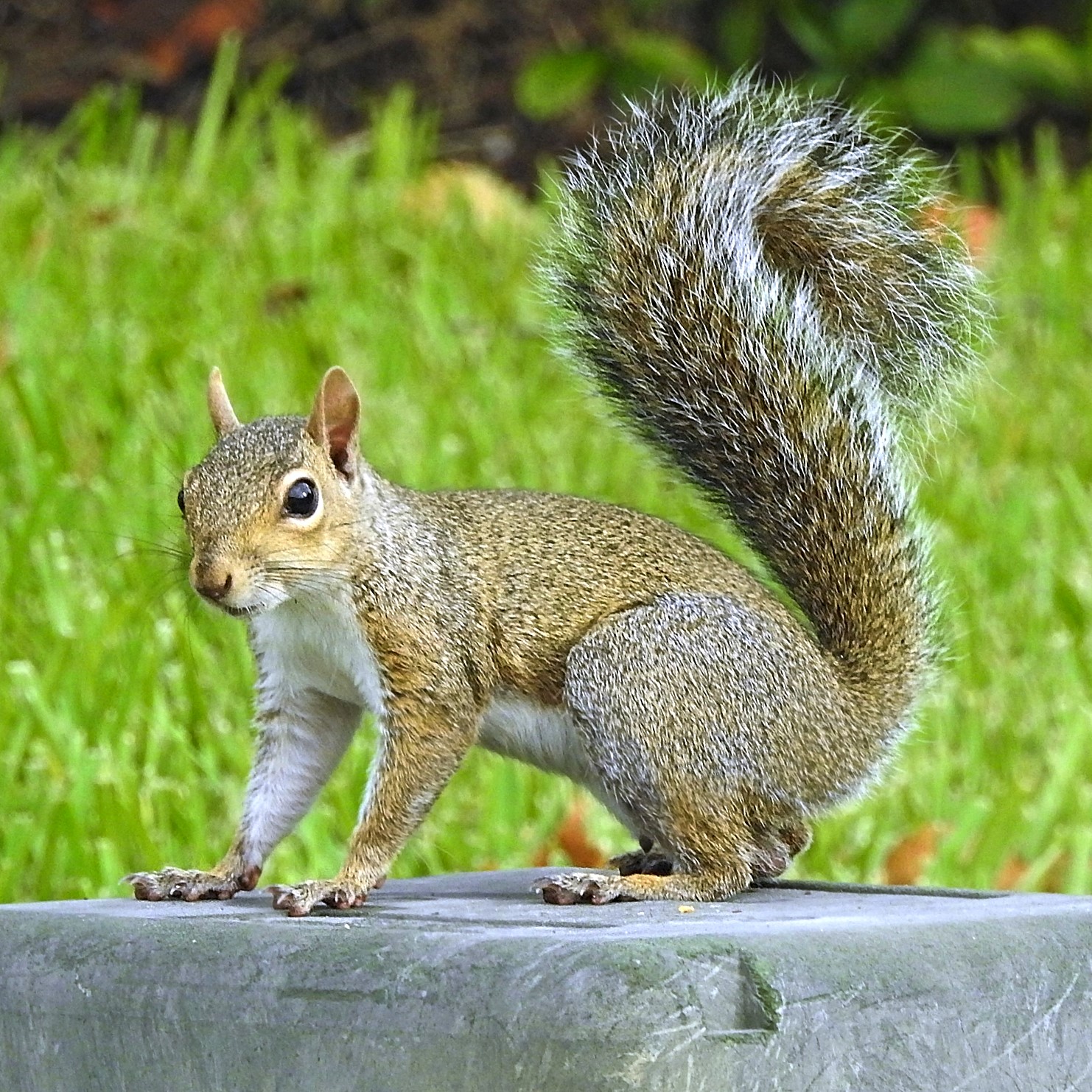
This is the large tree squirrel most people in Salem know best. Adults are about sixteen to twenty inches long including the tail, with a broad, fluffy tail nearly as long as the body. The coat is usually gray above and pale below, though individuals can look warm brown or silver depending on season and light. The ears are rounded, not tufted. The face is blunt, the movements are confident, and the tail is carried like a balancing pole.
They are noticeably bigger and heavier-bodied than Douglas squirrels, and much less tied to conifers. If the squirrel you are watching is stretched out on a maple limb or marching through the vegetable beds in full daylight, eastern gray squirrel is the likely answer.
Food, Theft, and Caching
Gray squirrels live by memory and nerve. They eat acorns, walnuts, hazelnuts, maple seeds, berries, mushrooms, tender shoots, and a steady share of human-supplied food. They raid bird feeders with professional focus, dig bulbs, and sample tomatoes with infuriating confidence.
The part worth respecting is the caching. In fall, gray squirrels bury nuts all over the neighborhood, including in lawn edges, mulch rings, and the loose top layer of amended beds. Not every cache gets recovered. Some of the volunteer oaks and walnuts that appear in Salem yards started as forgotten squirrel work. They are thieves, yes, but they are also accidental foresters.
Around The Patient Garden
At Shall and Audubon, gray squirrels use the larger deciduous trees as their backbone habitat. Bigleaf maple, Oregon white oak, red maple, flowering cherry, and any mature ornamental with a broad crown give them travel routes, lookout posts, and drey sites. The old Fairview site has the open feel they like, but it also has enough tree cover around the margins to let them move safely.
The Fairview clay does not bother them much directly, but it matters indirectly because it shapes the planting palette. Fruit trees, bulbs, and mulch-rich beds all concentrate food close to cover. A squirrel can feed in the garden and be back in a tree in seconds.
In late winter you will see them clipping twigs for nests and chasing hard through the canopy. In summer they sprawl on shaded branches in the afternoon heat. In fall they become frantic, carrying nuts one by one and burying them with a seriousness that would be moving if they were not also stealing sunflower seed.
Nesting and Seasonal Rhythm
Eastern gray squirrels build leafy dreys high in trees and also use cavities when they can find them. Litters are usually born in late winter and again in summer. Young squirrels appear suddenly, half-grown and reckless, testing long jumps they have no business attempting.
Winter does not send them underground. They stay active through Salem's cold wet months, leaving the nest on calmer mornings to feed and re-check caches. On rainy days they can disappear for hours, then reappear the minute the sky lightens.
Conservation and the Honest Assessment
Gray squirrels are abundant and need no special conservation help in Salem. The more interesting question is what they do to a neighborhood ecosystem. Because they are introduced and so adaptable, they compete for food and nesting space in ways that do not always favor native species. They also create regular friction with gardeners and bird-feeding humans.
Still, they are part of the daily life of the garden now. They prune twigs, move seed, feed hawks, and force us to notice how much of the site is edible if you are built to climb and remember. Watching one pause on the fence with its tail lifted, deciding whether the next leap is worth it, you get a small lesson in urban wildlife logic. The whole neighborhood is habitat if you are fast enough and bold enough to use it.
The Acrobat on the Fence
If you sit still in The Patient Garden for ten minutes, an eastern gray squirrel will usually show up and make the place feel less orderly. One runs the fence line with a black walnut in its mouth. Another hangs upside down from the suet feeder as if gravity were a minor suggestion. They are alert, opportunistic, and fully convinced that whatever we planted was planted partly for them.
Eastern gray squirrels are now one of the default neighborhood mammals in Salem, but they are not native to Oregon. They came west through introductions and urban expansion, and they thrive in the exact kind of mixed landscape that surrounds the old Fairview site: mature street trees, ornamental plantings, yards with feeders, and enough canopy connection to move block by block without spending much time on the ground.
Identification
This is the large tree squirrel most people in Salem know best. Adults are about sixteen to twenty inches long including the tail, with a broad, fluffy tail nearly as long as the body. The coat is usually gray above and pale below, though individuals can look warm brown or silver depending on season and light. The ears are rounded, not tufted. The face is blunt, the movements are confident, and the tail is carried like a balancing pole.
They are noticeably bigger and heavier-bodied than Douglas squirrels, and much less tied to conifers. If the squirrel you are watching is stretched out on a maple limb or marching through the vegetable beds in full daylight, eastern gray squirrel is the likely answer.
Food, Theft, and Caching
Gray squirrels live by memory and nerve. They eat acorns, walnuts, hazelnuts, maple seeds, berries, mushrooms, tender shoots, and a steady share of human-supplied food. They raid bird feeders with professional focus, dig bulbs, and sample tomatoes with infuriating confidence.
The part worth respecting is the caching. In fall, gray squirrels bury nuts all over the neighborhood, including in lawn edges, mulch rings, and the loose top layer of amended beds. Not every cache gets recovered. Some of the volunteer oaks and walnuts that appear in Salem yards started as forgotten squirrel work. They are thieves, yes, but they are also accidental foresters.
Around The Patient Garden
At Shall and Audubon, gray squirrels use the larger deciduous trees as their backbone habitat. Bigleaf maple, Oregon white oak, red maple, flowering cherry, and any mature ornamental with a broad crown give them travel routes, lookout posts, and drey sites. The old Fairview site has the open feel they like, but it also has enough tree cover around the margins to let them move safely.
The Fairview clay does not bother them much directly, but it matters indirectly because it shapes the planting palette. Fruit trees, bulbs, and mulch-rich beds all concentrate food close to cover. A squirrel can feed in the garden and be back in a tree in seconds.
In late winter you will see them clipping twigs for nests and chasing hard through the canopy. In summer they sprawl on shaded branches in the afternoon heat. In fall they become frantic, carrying nuts one by one and burying them with a seriousness that would be moving if they were not also stealing sunflower seed.
Nesting and Seasonal Rhythm
Eastern gray squirrels build leafy dreys high in trees and also use cavities when they can find them. Litters are usually born in late winter and again in summer. Young squirrels appear suddenly, half-grown and reckless, testing long jumps they have no business attempting.
Winter does not send them underground. They stay active through Salem's cold wet months, leaving the nest on calmer mornings to feed and re-check caches. On rainy days they can disappear for hours, then reappear the minute the sky lightens.
Conservation and the Honest Assessment
Gray squirrels are abundant and need no special conservation help in Salem. The more interesting question is what they do to a neighborhood ecosystem. Because they are introduced and so adaptable, they compete for food and nesting space in ways that do not always favor native species. They also create regular friction with gardeners and bird-feeding humans.
Still, they are part of the daily life of the garden now. They prune twigs, move seed, feed hawks, and force us to notice how much of the site is edible if you are built to climb and remember. Watching one pause on the fence with its tail lifted, deciding whether the next leap is worth it, you get a small lesson in urban wildlife logic. The whole neighborhood is habitat if you are fast enough and bold enough to use it.
Continue Continuar