Lady beetles Lady beetles
Coccinellidae
Lady beetles are the small round predators everyone wants in the garden, though the real story is more complicated and more interesting than one red beetle on a leaf. Around The Patient Garden, they are part of the aphid-control crew from the first flush of soft spring growth onward. Lady beetles are the small round predators everyone wants in the garden, though the real story is more complicated and more interesting than one red beetle on a leaf. Around The Patient Garden, they are part of the aphid-control crew from the first flush of soft spring growth onward.
The Predator People Actually Root For
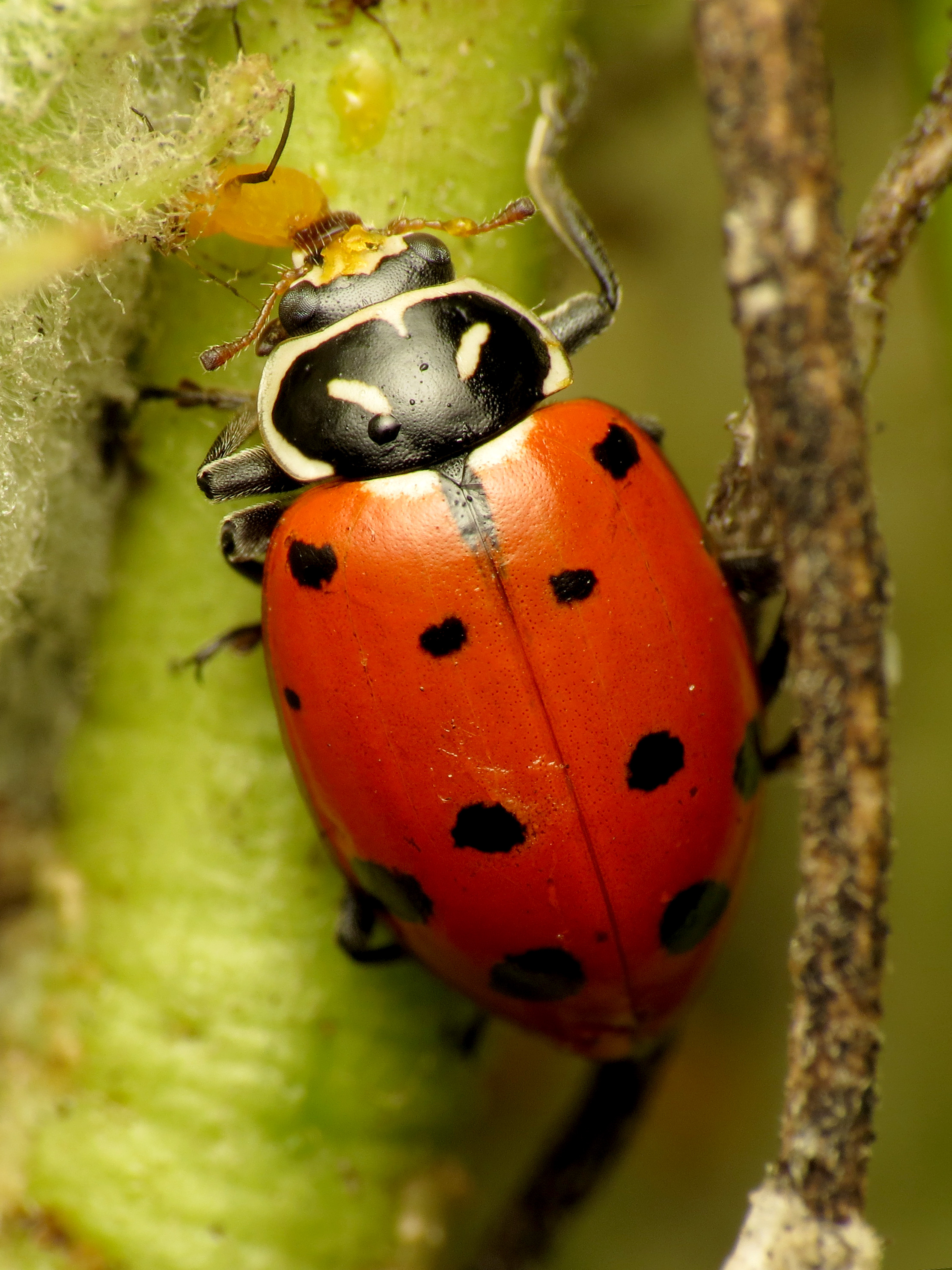
Most beneficial insects do not get much public affection, but lady beetles somehow do. Maybe it is the round shape, maybe the spots, maybe the fact that even children learn early that these little beetles are on the garden's side. Around Shall and Audubon, that reputation is mostly earned. Lady beetles and their larvae are serious aphid predators, and spring would look very different without them.
The only catch is that the classic red-and-black picture in most people's heads is only one version of the group. Lady beetles in Salem are a family story, not a single species story, and not every one we see is native.
Identification, Adult and Larva
Adult lady beetles are usually small dome-shaped beetles with rounded backs, short legs, and bold color patterns. Red with black spots is the familiar version, but orange, black, pink, yellow, and spotless forms also occur. Some species are native. Some are introduced. Some are easy to separate only if you are looking closely.
The larvae are the part many gardeners miss. They look nothing like the adults. A lady beetle larva is elongate, alligator-like at miniature scale, often dark with orange or yellow markings, and much more obviously predatory in posture. If you find one in an aphid colony, leave it exactly where it is.
Why Spring Growth Draws Them In
Lady beetles follow prey. Soft new growth in Salem gardens, especially in spring, tends to attract aphids. Roses, lupines, milkweed, fruit trees, tender shrubs, and many vegetables all produce the kind of fresh tissue aphids like best. Where the aphids go, lady beetles usually follow.
That is why a completely aphid-free garden is not actually the goal if you want beneficial insects. A small manageable population is how predators stay fed and present. The Patient Garden works best when the balance is allowed to form rather than being reset with spray every time a stem looks busy.
Around The Patient Garden
Lady beetles are regular around the flowering and vegetable-adjacent parts of the garden, but also in shrubby edges and tree canopies where early aphid blooms happen out of easy view. Fruit trees are especially important. Serviceberry, apple, plum, and other spring growth can host early prey and bring adults out quickly.
Flowering herbs and composites then help keep the adults supplied with nectar and pollen. That part matters because many lady beetles do not live on prey alone. A garden with both aphid colonies and accessible flowers becomes much more dependable habitat than one offering only a brief outbreak and nothing after.
The old Fairview site's mixed planting, open sun, and sheltered edge structure create that kind of sequence well. There is always some new growth somewhere, and there is usually bloom nearby once the season gets moving.
The Honest Complication
Lady beetles are not a perfectly simple good-news group. Some introduced species have displaced native ones in parts of North America, and commercially released lady beetles often do not stay where people want them. The best local strategy is not buying bags of beetles. It is building the habitat that supports the resident populations already using the neighborhood.
That means leaving some insect life in place, planting small nectar flowers, skipping broad insecticides, and accepting that a leaf with aphids is not automatically a crisis.
Seasonal Rhythm
Adults can show up very early on warm spring days, especially near aphid-rich shrubs and fruit trees. Numbers often rise through spring and early summer as prey builds. Later in the season, flowers and scattered prey keep them moving through the site. By fall they begin seeking sheltered overwintering places in bark, debris, dense vegetation, and other protected crevices.
That seasonality is easy to miss because the beetles are so small, but once you start looking, their rhythm is obvious. Early aphids, then predators. Summer bloom, then patrol. Autumn shelter, then quiet.
Why They Matter Here
Lady beetles are one of the clearest examples of what a living garden can provide back to itself. We plant flowers and shrubs for beauty, fruit, and structure, but those same plants also create prey and refuge for predators that help keep the system from tilting too far toward pest outbreaks.
In The Patient Garden, a lady beetle on a rose stem is not a cute extra. It is part of the actual operating system. The little bright beetle everyone recognizes turns out to represent a larger truth: a good garden is not clean of insects. It is full of the right arguments between them.
The Predator People Actually Root For
Most beneficial insects do not get much public affection, but lady beetles somehow do. Maybe it is the round shape, maybe the spots, maybe the fact that even children learn early that these little beetles are on the garden's side. Around Shall and Audubon, that reputation is mostly earned. Lady beetles and their larvae are serious aphid predators, and spring would look very different without them.
The only catch is that the classic red-and-black picture in most people's heads is only one version of the group. Lady beetles in Salem are a family story, not a single species story, and not every one we see is native.
Identification, Adult and Larva
Adult lady beetles are usually small dome-shaped beetles with rounded backs, short legs, and bold color patterns. Red with black spots is the familiar version, but orange, black, pink, yellow, and spotless forms also occur. Some species are native. Some are introduced. Some are easy to separate only if you are looking closely.
The larvae are the part many gardeners miss. They look nothing like the adults. A lady beetle larva is elongate, alligator-like at miniature scale, often dark with orange or yellow markings, and much more obviously predatory in posture. If you find one in an aphid colony, leave it exactly where it is.
Why Spring Growth Draws Them In
Lady beetles follow prey. Soft new growth in Salem gardens, especially in spring, tends to attract aphids. Roses, lupines, milkweed, fruit trees, tender shrubs, and many vegetables all produce the kind of fresh tissue aphids like best. Where the aphids go, lady beetles usually follow.
That is why a completely aphid-free garden is not actually the goal if you want beneficial insects. A small manageable population is how predators stay fed and present. The Patient Garden works best when the balance is allowed to form rather than being reset with spray every time a stem looks busy.
Around The Patient Garden
Lady beetles are regular around the flowering and vegetable-adjacent parts of the garden, but also in shrubby edges and tree canopies where early aphid blooms happen out of easy view. Fruit trees are especially important. Serviceberry, apple, plum, and other spring growth can host early prey and bring adults out quickly.
Flowering herbs and composites then help keep the adults supplied with nectar and pollen. That part matters because many lady beetles do not live on prey alone. A garden with both aphid colonies and accessible flowers becomes much more dependable habitat than one offering only a brief outbreak and nothing after.
The old Fairview site's mixed planting, open sun, and sheltered edge structure create that kind of sequence well. There is always some new growth somewhere, and there is usually bloom nearby once the season gets moving.
The Honest Complication
Lady beetles are not a perfectly simple good-news group. Some introduced species have displaced native ones in parts of North America, and commercially released lady beetles often do not stay where people want them. The best local strategy is not buying bags of beetles. It is building the habitat that supports the resident populations already using the neighborhood.
That means leaving some insect life in place, planting small nectar flowers, skipping broad insecticides, and accepting that a leaf with aphids is not automatically a crisis.
Seasonal Rhythm
Adults can show up very early on warm spring days, especially near aphid-rich shrubs and fruit trees. Numbers often rise through spring and early summer as prey builds. Later in the season, flowers and scattered prey keep them moving through the site. By fall they begin seeking sheltered overwintering places in bark, debris, dense vegetation, and other protected crevices.
That seasonality is easy to miss because the beetles are so small, but once you start looking, their rhythm is obvious. Early aphids, then predators. Summer bloom, then patrol. Autumn shelter, then quiet.
Why They Matter Here
Lady beetles are one of the clearest examples of what a living garden can provide back to itself. We plant flowers and shrubs for beauty, fruit, and structure, but those same plants also create prey and refuge for predators that help keep the system from tilting too far toward pest outbreaks.
In The Patient Garden, a lady beetle on a rose stem is not a cute extra. It is part of the actual operating system. The little bright beetle everyone recognizes turns out to represent a larger truth: a good garden is not clean of insects. It is full of the right arguments between them.
Continue Continuar