Mason bees Mason bees
Osmia spp.
Mason bees are the neat, efficient spring pollinators of backyard orchards, smaller than bumblebees and quieter in presence but often even more useful when fruit trees bloom. Around Fairview, they arrive exactly when Salem gardens need them most. Mason bees are the neat, efficient spring pollinators of backyard orchards, smaller than bumblebees and quieter in presence but often even more useful when fruit trees bloom. Around Fairview, they arrive exactly when Salem gardens need them most.
The Spring Pollinator With Mud on the Job Site
Mason bees do not dominate the flower border the way bumblebees do, and they do not announce themselves with much sound. What they do instead is work the orchard season with an efficiency that makes gardeners quietly devoted to them. When apples, cherries, plums, and serviceberries bloom around Shall and Audubon, mason bees are often among the best pollinators in the neighborhood.
They are called mason bees for a practical reason. Females partition their nest cells with mud. On the Fairview clay, that detail feels especially local. The soil that gives us drainage headaches also gives mason bees building material.
Identification
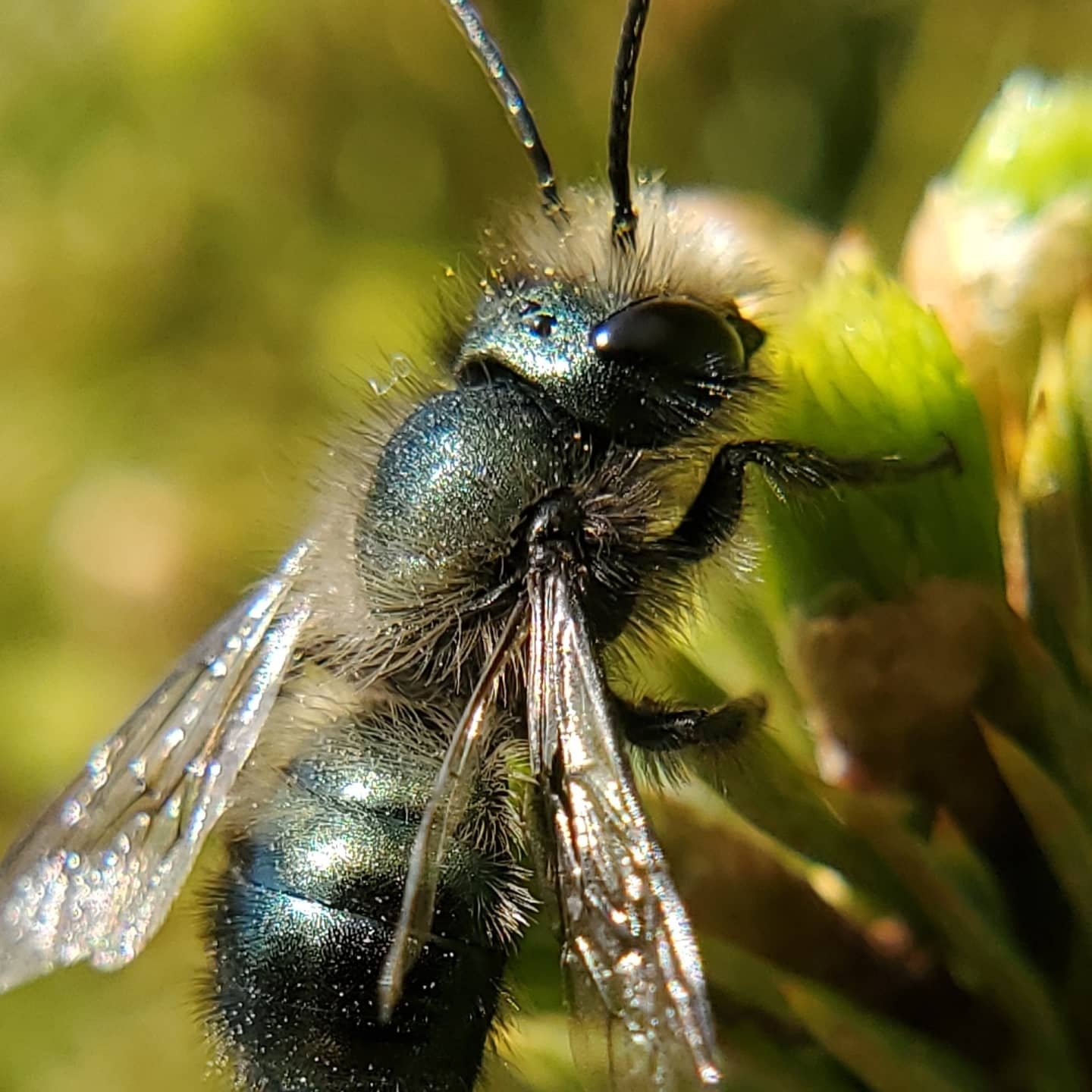
Mason bees are solitary bees, not colony bees. Each female builds and provisions her own nest. Many of the species gardeners notice most are compact, dark, and often metallic blue or blue-green in good light. They look sturdy rather than fuzzy-luxurious, and they carry pollen on the hairs under the abdomen rather than in the leg baskets you see on honeybees and bumblebees.
A bee returning to a nest tube or cavity with a dusty yellow underside is often your clue. Once you know that look, you start seeing mason bees as workers with a tool belt rather than just small general-purpose bees.
Why Spring Belongs to Them
Mason bees are early-season specialists in the sense that their life cycle lines up beautifully with fruit tree and shrub bloom. Adults emerge in spring, mate, forage intensively, provision nest cells, and then disappear from the active garden long before late summer. The next generation develops inside the sealed nest and overwinters there.
That means their visible season is brief but important. If you have apples, cherries, plums, currants, serviceberries, or other spring-blooming plants, mason bees can do a great deal of the pollination work in a small window when weather is still mixed and other pollinators may be inconsistent.
Around The Patient Garden
At The Patient Garden, mason bees belong to the orchard and shrub season first. They move through fruit tree blossom, native and ornamental spring bloom, and any early herb flowers that overlap with their flight period. They are quick, focused visitors, less likely to linger conspicuously than bumblebees and more likely to vanish back toward a cavity in a fence post, bee house, dead stem, or old wood.
This is where the broader structure of the old Fairview site matters. Mason bees need forage, but they also need nesting holes. Hollow stems, drilled blocks, old wood with beetle holes, and other small protected cavities all help. The best sites warm gently in the morning, stay dry, and sit close to strong bloom.
And then there is the mud. Females need workable mud to seal brood cells. A little damp soil at the edge of a bed or path can serve that purpose beautifully. We do not usually think of exposed damp soil as pollinator infrastructure, but for mason bees it absolutely is.
Solitary Does Not Mean Rare
Because they do not form obvious hives, mason bees are easy to underestimate. A garden can host dozens of active females and still feel quiet. But their pollination value is disproportionate. They are efficient flower visitors and less likely than honeybees to ignore cool spring conditions.
They are also gentle. Females can sting, but rarely do, and males cannot sting at all. Around the garden they are among the least troublesome bees people encounter.
Care and Conservation
The practical way to support mason bees is straightforward: plant early bloom, leave or provide nest cavities, keep some mud available in spring, and avoid pesticide use during bloom. If using artificial bee houses, keep them clean and managed rather than treating them as permanent decorative objects. Poorly maintained houses can concentrate parasites and disease.
Mason bees fit The Patient Garden perfectly because they reward small, thoughtful acts. A flowering apple, a patch of damp soil, a dry nest tube under shelter, and the whole system starts working. When you watch one disappear into a cavity with pollen under its belly and mud waiting nearby, the whole spring garden feels organized around useful labor.
The Spring Pollinator With Mud on the Job Site
Mason bees do not dominate the flower border the way bumblebees do, and they do not announce themselves with much sound. What they do instead is work the orchard season with an efficiency that makes gardeners quietly devoted to them. When apples, cherries, plums, and serviceberries bloom around Shall and Audubon, mason bees are often among the best pollinators in the neighborhood.
They are called mason bees for a practical reason. Females partition their nest cells with mud. On the Fairview clay, that detail feels especially local. The soil that gives us drainage headaches also gives mason bees building material.
Identification
Mason bees are solitary bees, not colony bees. Each female builds and provisions her own nest. Many of the species gardeners notice most are compact, dark, and often metallic blue or blue-green in good light. They look sturdy rather than fuzzy-luxurious, and they carry pollen on the hairs under the abdomen rather than in the leg baskets you see on honeybees and bumblebees.
A bee returning to a nest tube or cavity with a dusty yellow underside is often your clue. Once you know that look, you start seeing mason bees as workers with a tool belt rather than just small general-purpose bees.
Why Spring Belongs to Them
Mason bees are early-season specialists in the sense that their life cycle lines up beautifully with fruit tree and shrub bloom. Adults emerge in spring, mate, forage intensively, provision nest cells, and then disappear from the active garden long before late summer. The next generation develops inside the sealed nest and overwinters there.
That means their visible season is brief but important. If you have apples, cherries, plums, currants, serviceberries, or other spring-blooming plants, mason bees can do a great deal of the pollination work in a small window when weather is still mixed and other pollinators may be inconsistent.
Around The Patient Garden
At The Patient Garden, mason bees belong to the orchard and shrub season first. They move through fruit tree blossom, native and ornamental spring bloom, and any early herb flowers that overlap with their flight period. They are quick, focused visitors, less likely to linger conspicuously than bumblebees and more likely to vanish back toward a cavity in a fence post, bee house, dead stem, or old wood.
This is where the broader structure of the old Fairview site matters. Mason bees need forage, but they also need nesting holes. Hollow stems, drilled blocks, old wood with beetle holes, and other small protected cavities all help. The best sites warm gently in the morning, stay dry, and sit close to strong bloom.
And then there is the mud. Females need workable mud to seal brood cells. A little damp soil at the edge of a bed or path can serve that purpose beautifully. We do not usually think of exposed damp soil as pollinator infrastructure, but for mason bees it absolutely is.
Solitary Does Not Mean Rare
Because they do not form obvious hives, mason bees are easy to underestimate. A garden can host dozens of active females and still feel quiet. But their pollination value is disproportionate. They are efficient flower visitors and less likely than honeybees to ignore cool spring conditions.
They are also gentle. Females can sting, but rarely do, and males cannot sting at all. Around the garden they are among the least troublesome bees people encounter.
Care and Conservation
The practical way to support mason bees is straightforward: plant early bloom, leave or provide nest cavities, keep some mud available in spring, and avoid pesticide use during bloom. If using artificial bee houses, keep them clean and managed rather than treating them as permanent decorative objects. Poorly maintained houses can concentrate parasites and disease.
Mason bees fit The Patient Garden perfectly because they reward small, thoughtful acts. A flowering apple, a patch of damp soil, a dry nest tube under shelter, and the whole system starts working. When you watch one disappear into a cavity with pollen under its belly and mud waiting nearby, the whole spring garden feels organized around useful labor.
Continue Continuar