Northwestern garter snake Northwestern garter snake
Thamnophis ordinoides
Northwestern garter snakes are the slim, alert little snakes of western Oregon gardens, often seen as a moving stripe in grass before they vanish under the nearest cover. Around Fairview, they use damp edges, leaf litter, and dense planting as both pantry and refuge. Northwestern garter snakes are the slim, alert little snakes of western Oregon gardens, often seen as a moving stripe in grass before they vanish under the nearest cover. Around Fairview, they use damp edges, leaf litter, and dense planting as both pantry and refuge.
The Stripe That Moves Before You Register Snake
Most sightings of northwestern garter snakes begin with a mistaken impression that a blade of grass moved the wrong way. Then the line resolves into a small snake sliding between stems or freezing under the lip of a bed. That quickness, along with their modest size, makes them one of the easier snakes to live beside and one of the easier snakes to miss.
For many neighborhoods, that is lucky. Garter snakes do quiet ecological work. They eat the small soft-bodied creatures that thrive in moist gardens, and they ask for very little in return beyond cover, prey, and a little tolerance.
Identification
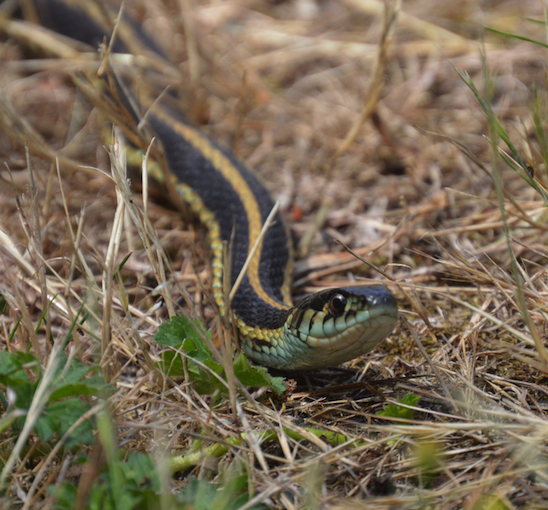
Northwestern garter snakes are small, slender snakes with tremendous variation in color and striping. Many have a yellow or pale dorsal stripe with side striping on a dark brown, olive, black, or reddish ground color. Others look muted enough that the striping only appears when the snake turns in good light. Adults are usually well under three feet and often much shorter.
The head is narrow, the movement smooth and quick, and the overall build finer than the chunkier larger garter species people sometimes expect. If you are used to thinking of snakes as thick-bodied, this one can seem almost threadlike by comparison.
Why Gardens Suit Them
Northwestern garter snakes are tied to moisture more than people realize. They feed on slugs, worms, amphibians, small fish in some settings, and other small soft prey. The old Fairview site and its surrounding gardens create a useful mix: wet-season puddles, damp mulch, dense shrubs, and edges where frogs, newts, and invertebrates gather.
The Fairview clay is part of that story. It slows drainage, keeps some margins cool and damp, and supports exactly the slug-rich and worm-rich conditions that make a garden attractive to a small hunting snake. A perfectly dry, exposed ornamental bed is less useful than a mixed border with cover and a little retained moisture underneath.
Around The Patient Garden
In The Patient Garden, northwestern garter snakes are most likely in the low hidden layer. They travel under boards, through ivy-free but still dense groundcover, beneath shrubs, and along the seam where path meets planting. They bask briefly when the sun is right, but not for long. A patch of warm stone near cover may hold one for a few minutes on a spring morning, then the snake is gone again.
Amphibian-rich corners are especially promising. A garden that supports Pacific tree frogs or rough-skinned newts is also a garden that may attract garter snakes. That does not make the place dangerous. It makes it ecologically connected.
Seasonal Rhythm
These snakes are most visible from spring through early fall, when the ground is warm enough for regular activity but still moist enough to support their prey. Spring mornings after a cool wet night are excellent garter-snake weather. The animals come out to warm, hunt, and move between cover patches.
As summer heat builds, activity shifts earlier and later in the day, especially in exposed places. The snake stays close to shaded retreat sites where soil and mulch still hold moisture. By late fall, colder conditions reduce movement sharply.
Human Fear and Actual Risk
Northwestern garter snakes are harmless to people. They may musk or nip if handled, but they are not venomous in any practical neighborhood sense and they are not interested in confrontation. The right response to finding one in the garden is appreciation and a little patience while it exits on its own schedule.
That matters because small non-dangerous snakes are often killed out of reflex. Every time that happens, the garden loses one of its best slug and soft-bodied prey hunters.
Conservation and Coexistence
This species is not broadly scarce in western Oregon, but local abundance depends on habitat texture. Remove all ground cover, all loggy edges, all damp corners, and all rough structure, and snakes vanish even if the broader climate is still suitable. Leave some complexity in place and they persist.
In The Patient Garden, a northwestern garter snake is a good sign. It means the site still has enough cover, prey, and moisture variation to support a predator that lives close to the ground and cannot afford exposure for long. Seen that way, the little moving stripe in the mulch is not a problem at all. It is evidence that the garden still has a bottom layer of life worth protecting.
The Stripe That Moves Before You Register Snake
Most sightings of northwestern garter snakes begin with a mistaken impression that a blade of grass moved the wrong way. Then the line resolves into a small snake sliding between stems or freezing under the lip of a bed. That quickness, along with their modest size, makes them one of the easier snakes to live beside and one of the easier snakes to miss.
For many neighborhoods, that is lucky. Garter snakes do quiet ecological work. They eat the small soft-bodied creatures that thrive in moist gardens, and they ask for very little in return beyond cover, prey, and a little tolerance.
Identification
Northwestern garter snakes are small, slender snakes with tremendous variation in color and striping. Many have a yellow or pale dorsal stripe with side striping on a dark brown, olive, black, or reddish ground color. Others look muted enough that the striping only appears when the snake turns in good light. Adults are usually well under three feet and often much shorter.
The head is narrow, the movement smooth and quick, and the overall build finer than the chunkier larger garter species people sometimes expect. If you are used to thinking of snakes as thick-bodied, this one can seem almost threadlike by comparison.
Why Gardens Suit Them
Northwestern garter snakes are tied to moisture more than people realize. They feed on slugs, worms, amphibians, small fish in some settings, and other small soft prey. The old Fairview site and its surrounding gardens create a useful mix: wet-season puddles, damp mulch, dense shrubs, and edges where frogs, newts, and invertebrates gather.
The Fairview clay is part of that story. It slows drainage, keeps some margins cool and damp, and supports exactly the slug-rich and worm-rich conditions that make a garden attractive to a small hunting snake. A perfectly dry, exposed ornamental bed is less useful than a mixed border with cover and a little retained moisture underneath.
Around The Patient Garden
In The Patient Garden, northwestern garter snakes are most likely in the low hidden layer. They travel under boards, through ivy-free but still dense groundcover, beneath shrubs, and along the seam where path meets planting. They bask briefly when the sun is right, but not for long. A patch of warm stone near cover may hold one for a few minutes on a spring morning, then the snake is gone again.
Amphibian-rich corners are especially promising. A garden that supports Pacific tree frogs or rough-skinned newts is also a garden that may attract garter snakes. That does not make the place dangerous. It makes it ecologically connected.
Seasonal Rhythm
These snakes are most visible from spring through early fall, when the ground is warm enough for regular activity but still moist enough to support their prey. Spring mornings after a cool wet night are excellent garter-snake weather. The animals come out to warm, hunt, and move between cover patches.
As summer heat builds, activity shifts earlier and later in the day, especially in exposed places. The snake stays close to shaded retreat sites where soil and mulch still hold moisture. By late fall, colder conditions reduce movement sharply.
Human Fear and Actual Risk
Northwestern garter snakes are harmless to people. They may musk or nip if handled, but they are not venomous in any practical neighborhood sense and they are not interested in confrontation. The right response to finding one in the garden is appreciation and a little patience while it exits on its own schedule.
That matters because small non-dangerous snakes are often killed out of reflex. Every time that happens, the garden loses one of its best slug and soft-bodied prey hunters.
Conservation and Coexistence
This species is not broadly scarce in western Oregon, but local abundance depends on habitat texture. Remove all ground cover, all loggy edges, all damp corners, and all rough structure, and snakes vanish even if the broader climate is still suitable. Leave some complexity in place and they persist.
In The Patient Garden, a northwestern garter snake is a good sign. It means the site still has enough cover, prey, and moisture variation to support a predator that lives close to the ground and cannot afford exposure for long. Seen that way, the little moving stripe in the mulch is not a problem at all. It is evidence that the garden still has a bottom layer of life worth protecting.
Continue Continuar