Rough-skinned newt Rough-skinned newt
Taricha granulosa
Rough-skinned newts are the slow, deliberate amphibians of wet Pacific Northwest winters, dark above and warning-bright below. Around Fairview, they appear where damp cover, seasonal water, and leaf litter still let an ancient sort of life move across the ground. Rough-skinned newts are the slow, deliberate amphibians of wet Pacific Northwest winters, dark above and warning-bright below. Around Fairview, they appear where damp cover, seasonal water, and leaf litter still let an ancient sort of life move across the ground.
The Small Amphibian That Walks Like It Has Time
A rough-skinned newt crossing a path does not hurry for anybody. It moves with the stubborn calm of an animal that has survived by being chemically untouchable more often than by being fast. On a wet Salem day, that pace makes sense. The ground is cool, the air is damp, and the leaf litter along the edges of the old Fairview site is finally wet enough to travel through. This is newt weather.
They are one of the most characteristic amphibians of western Oregon, but many people only encounter them in passing, halfway between rainstorm and errand, when one appears on a sidewalk or path and turns the whole day into a reminder that we share the neighborhood with older, stranger lineages than we usually notice.
Identification
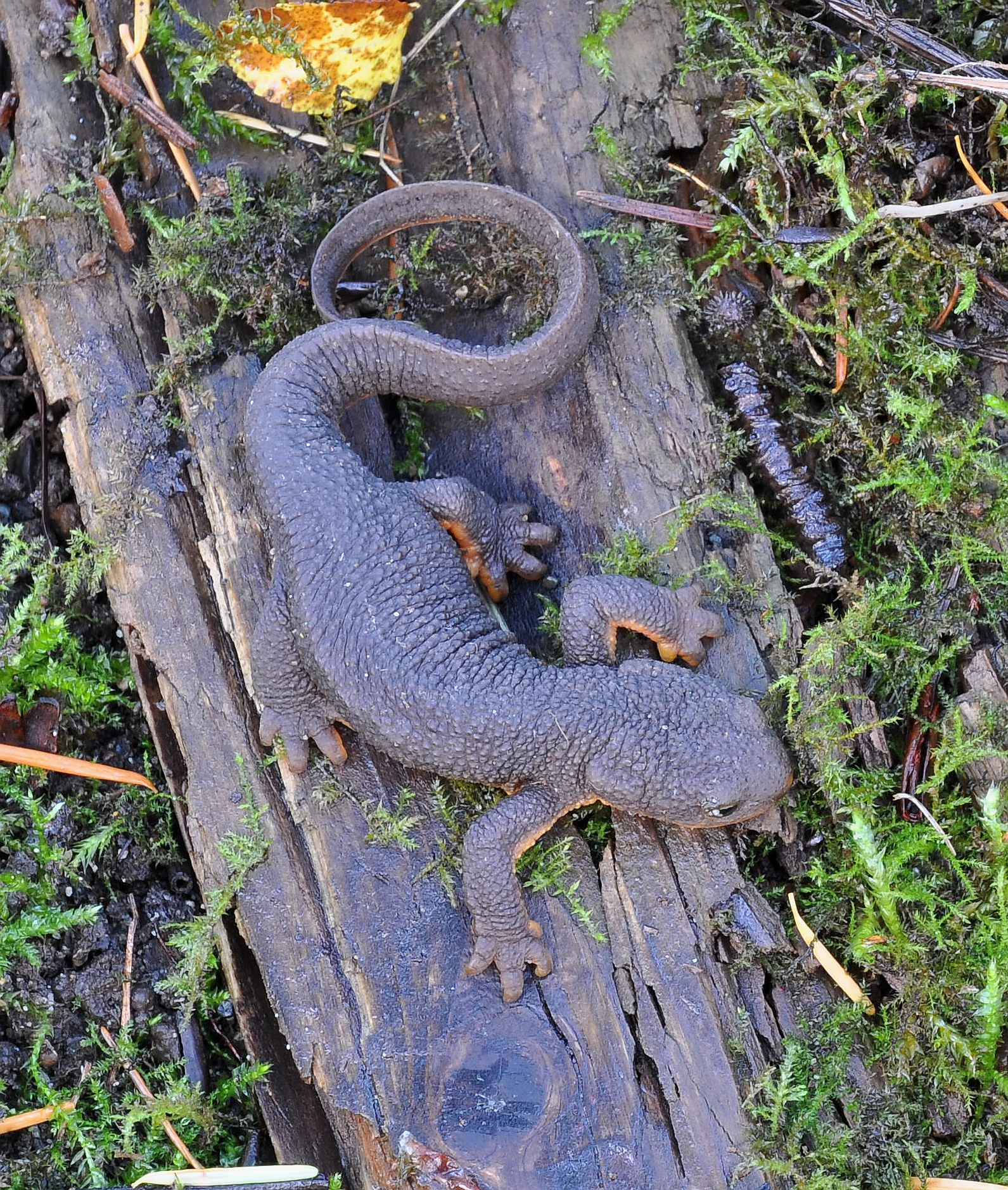
Rough-skinned newts are medium-sized salamanders, usually three to six inches long, dark brown to olive above with slightly grainy skin and a vivid orange to yellow-orange belly beneath. The back often looks almost plain until the animal lifts or curves and the underside flashes into view. That bright belly is warning coloration. This species carries tetrodotoxin, one of the more powerful natural toxins found in vertebrates.
The practical lesson is simple. Admire, do not handle. Pets especially should be kept away.
Wet Season Travelers
Around Salem, rough-skinned newts are most visible in the wet season. Rain draws them out from cover under logs, bark, dense vegetation, and damp soil cavities. They move toward breeding water, disperse between sheltered patches, and sometimes wind up crossing paths, driveways, or road shoulders in the process.
The old Fairview site can support that movement where damp cover remains intact. Seasonal wet spots, drainage swales, shaded planted edges, and the protected undersides of woody debris all help. The Fairview clay works in their favor when it holds moisture late into winter and spring. Dry crumbly ground closes the door on newt movement. Moist leaf litter opens it.
Breeding Water and Summer Refuge
Newts breed in ponds, slow ditches, wetland margins, and other shallow still water. Adults enter the water in the cooler months, court, and lay eggs singly on submerged vegetation. Larvae spend weeks to months in the water before metamorphosing into small land-going juveniles.
The surrounding terrestrial habitat matters just as much. A breeding basin without nearby cover is not enough. Newts need cool retreat sites for the long non-breeding part of the year. That means logs, leaf litter, dense shrub shade, mossy ground, and soil that does not bake hard too early in the season.
In The Patient Garden, that points us toward the quieter, shadier corners rather than the hottest ornamental edges. A damp wooded margin with leaf mold and rough debris is much better newt country than a neat gravel strip.
Defense and the Famous Belly Display
When threatened, rough-skinned newts may arch the body and lift the tail to expose the bright underside. The message is honest: do not eat me. Many predators learn it quickly. Garter snakes are the famous exception in some places, with certain populations evolving partial resistance, but for most predators the warning works.
That defensive confidence gives newts an unusual quality. They are not panicked creatures. They move carefully, and if the ground is wet enough they keep going. There is something almost prehistoric about watching one cross a muddy margin at the old Fairview site while winter rain falls on the firs.
Conservation and Careful Attention
Rough-skinned newts are still widespread in western Oregon, but local populations depend on a combination that is easy to break: clean seasonal or semi-permanent water plus cool protected upland cover nearby. Fill or contaminate the water, scrape away the debris, compact the margins, or run roads through the movement routes, and losses follow.
The neighborhood-scale care they need is not complicated. Keep wet edges vegetated. Leave some coarse organic cover in the shadier zones. Avoid handling. Watch for road crossings in rainy weather. Respect the parts of the site that stay damp and half-wild through winter.
Newts do not make big dramatic claims on the garden. They do not sing, and they are rarely abundant in plain sight. What they offer instead is depth. If a rough-skinned newt can still move through the old Fairview site in January, then the place still holds enough moisture, shade, and patience for amphibian life. That is not nothing.
The Small Amphibian That Walks Like It Has Time
A rough-skinned newt crossing a path does not hurry for anybody. It moves with the stubborn calm of an animal that has survived by being chemically untouchable more often than by being fast. On a wet Salem day, that pace makes sense. The ground is cool, the air is damp, and the leaf litter along the edges of the old Fairview site is finally wet enough to travel through. This is newt weather.
They are one of the most characteristic amphibians of western Oregon, but many people only encounter them in passing, halfway between rainstorm and errand, when one appears on a sidewalk or path and turns the whole day into a reminder that we share the neighborhood with older, stranger lineages than we usually notice.
Identification
Rough-skinned newts are medium-sized salamanders, usually three to six inches long, dark brown to olive above with slightly grainy skin and a vivid orange to yellow-orange belly beneath. The back often looks almost plain until the animal lifts or curves and the underside flashes into view. That bright belly is warning coloration. This species carries tetrodotoxin, one of the more powerful natural toxins found in vertebrates.
The practical lesson is simple. Admire, do not handle. Pets especially should be kept away.
Wet Season Travelers
Around Salem, rough-skinned newts are most visible in the wet season. Rain draws them out from cover under logs, bark, dense vegetation, and damp soil cavities. They move toward breeding water, disperse between sheltered patches, and sometimes wind up crossing paths, driveways, or road shoulders in the process.
The old Fairview site can support that movement where damp cover remains intact. Seasonal wet spots, drainage swales, shaded planted edges, and the protected undersides of woody debris all help. The Fairview clay works in their favor when it holds moisture late into winter and spring. Dry crumbly ground closes the door on newt movement. Moist leaf litter opens it.
Breeding Water and Summer Refuge
Newts breed in ponds, slow ditches, wetland margins, and other shallow still water. Adults enter the water in the cooler months, court, and lay eggs singly on submerged vegetation. Larvae spend weeks to months in the water before metamorphosing into small land-going juveniles.
The surrounding terrestrial habitat matters just as much. A breeding basin without nearby cover is not enough. Newts need cool retreat sites for the long non-breeding part of the year. That means logs, leaf litter, dense shrub shade, mossy ground, and soil that does not bake hard too early in the season.
In The Patient Garden, that points us toward the quieter, shadier corners rather than the hottest ornamental edges. A damp wooded margin with leaf mold and rough debris is much better newt country than a neat gravel strip.
Defense and the Famous Belly Display
When threatened, rough-skinned newts may arch the body and lift the tail to expose the bright underside. The message is honest: do not eat me. Many predators learn it quickly. Garter snakes are the famous exception in some places, with certain populations evolving partial resistance, but for most predators the warning works.
That defensive confidence gives newts an unusual quality. They are not panicked creatures. They move carefully, and if the ground is wet enough they keep going. There is something almost prehistoric about watching one cross a muddy margin at the old Fairview site while winter rain falls on the firs.
Conservation and Careful Attention
Rough-skinned newts are still widespread in western Oregon, but local populations depend on a combination that is easy to break: clean seasonal or semi-permanent water plus cool protected upland cover nearby. Fill or contaminate the water, scrape away the debris, compact the margins, or run roads through the movement routes, and losses follow.
The neighborhood-scale care they need is not complicated. Keep wet edges vegetated. Leave some coarse organic cover in the shadier zones. Avoid handling. Watch for road crossings in rainy weather. Respect the parts of the site that stay damp and half-wild through winter.
Newts do not make big dramatic claims on the garden. They do not sing, and they are rarely abundant in plain sight. What they offer instead is depth. If a rough-skinned newt can still move through the old Fairview site in January, then the place still holds enough moisture, shade, and patience for amphibian life. That is not nothing.
Continue Continuar